
Most jaw clicking is harmless. Here’s what the sound means, why it can happen on one side, and the signs that it’s time for an exam.
A jaw that clicks or pops without pain is common, and it usually isn’t a problem. The National Institute of Dental and Craniofacial Research (NIDCR) says clicking or popping in the jaw joint without pain is normal and doesn’t need treatment. Get it checked if the click hurts, if your jaw catches or locks, or if the way your teeth fit together changes.
That’s the short answer. The longer one is more useful, because the sound itself can tell you a lot.
Below, we’ll explain what’s making the noise, why it often happens on just one side, and how to tell a harmless click from one that needs a closer look. If you already know your click hurts, you can skip ahead and book a TMJ evaluation.
Why does my jaw pop?
Most jaw popping comes from a small disc inside the jaw joint. The disc slips a little out of place, then snaps back as you open or close your mouth. That quick slip is the pop you hear.
You have a jaw joint in front of each ear. It’s called the temporomandibular joint, or TMJ. The rounded top of your lower jaw sits in a shallow socket in your skull.
When you open wide, that rounded end doesn’t just swing like a door hinge. It also slides forward. A small disc of cartilage rides along with it, like a cushion between the bone and the socket.
Sometimes the disc sits a little too far forward. Then the jaw has to slip past the edge of the disc as you open, and you hear a click. When you close, the disc can slide off again, so some people hear a second, softer click.
That’s the most common reason, but it’s not the only one. The type of sound, and when you hear it, says a lot about what’s going on.
What your jaw sound may be telling you
| The sound | When you hear it | What’s usually going on | Get it checked? |
|---|---|---|---|
| One pop near the end of a big yawn or wide bite | Only when you open very wide | The jaw slides a little past a bump in the joint. This is usually normal. | Only if it hurts |
| A click when you open, and sometimes again when you close | Opening, talking, or chewing | The disc slips forward and then snaps back into place. | If it hurts, catches, or locks |
| A grating or crunching feel, like sand | Chewing or moving your jaw side to side | The surfaces inside the joint may be wearing, sometimes from arthritis. | If you have pain or stiffness |
| A click that suddenly stops, and you can’t open as wide | When you try to open | The disc may no longer be slipping back into place. | Yes, soon |
| Your jaw gets stuck open | After a wide yawn or bite | The jaw has slid too far forward and can’t get back on its own. | Yes, the same day |
Dentist Gary Lowder, DDS, describes the same split in an interview with University of Utah Health. A pop near full opening is usually just the jaw stretching a little too far. A click from a shifted disc is the kind to keep an eye on, and if it’s painful, it should be checked.
Tight, tired jaw muscles can add to the problem. Clenching, grinding your teeth at night, chewing a lot of gum, and biting your nails all put extra work on the joint. Mayo Clinic lists those habits, along with jaw injuries, arthritis, and stress, as risk factors for jaw joint problems.
Is jaw clicking normal if it doesn’t hurt?
Clicking on one side usually means the disc in that one joint is the one shifting. You have two jaw joints, one in front of each ear. They work as a pair, but each one has its own disc, so one side can click while the other stays quiet.
One-sided clicking is very common, and the same rule applies. If it doesn’t hurt, it’s usually fine.
A few things can make one side work harder than the other:
– Chewing mostly on one side, often to avoid a sore or broken tooth
– An old bump or injury to that side of your face or jaw
– Clenching or grinding that’s heavier on one side
Pay closer attention if that side starts to hurt, if it catches, or if your jaw drifts toward that side when you open. Those are signs the joint is doing more than just making noise.
If you’ve been chewing on one side to protect a tooth, that tooth needs a look too. A cracked or sore tooth is easy to fix early and harder to fix later.
Why does my jaw pop when I chew?
Chewing opens and closes your jaw over and over, so a disc that’s a little out of place gets more chances to click. If it doesn’t hurt, a click when you chew is in the same normal range as any other painless click.
Chewing is often where problems show up first, though. Watch for these:
– Your jaw aches or feels tired by the end of a meal
– Tough foods like steak, bagels, or gum make it worse
– Your jaw catches for a second before it clicks
Here’s how a click when you chew compares with a click when you open wide.
| Clicking when you open wide | Clicking when you chew | |
|---|---|---|
| When it happens | Big yawns, wide bites, singing | During meals or when chewing gum |
| Usual cause | The jaw sliding a little past a bump in the joint, or the disc snapping back | The disc slipping with each chew, sometimes with tired chewing muscles |
| Normal? | Usually, if it doesn’t hurt | Usually, if it doesn’t hurt |
| What helps | Opening a little less wide | Softer foods for a while, smaller bites, less gum |
| Get it checked if | It hurts, or your jaw gets stuck open | Your jaw aches after meals, or it catches |
Did the clicking or aching start right after a new filling or crown, and does your bite feel off? Call the office that did the work. A filling that sits a little high makes your teeth hit it first every time you bite. That’s usually a quick adjustment, not something to wait out.
When should I worry about my jaw clicking?
Get your jaw checked if the click comes with pain, catching, locking, or a change in how your teeth fit together. A painless click on its own can wait for your next checkup.
Signs it’s time for an exam:
– The click hurts, or you have pain in front of your ear
– Your jaw catches, sticks, or locks, even for a moment
– The click suddenly stopped, and now you can’t open as wide
– You can’t fit three fingers between your front teeth (see the test below)
– Your teeth suddenly fit together differently
– The clicking started after a fall, a hit to the face, or a car accident
– Your jaw is sore when you wake up, or your teeth feel sore in the morning
– Your teeth are chipped, cracked, or worn flat
The last two are signs of clenching or grinding, which we’ll come back to below.
| When jaw trouble can’t wait |
| Call 911 if jaw pain comes with chest pressure, shortness of breath, sweating, or pain spreading to your arm. That can be a heart attack.Get care the same day if your jaw is stuck open or shut, if you have swelling with a fever, or if the pain started after an injury. Don’t try to pop a stuck jaw back into place yourself. |
What is the 3-finger test for TMJ?
The 3-finger test is a quick home check of how wide your mouth opens. It can’t diagnose a jaw problem, but it can tell you if your opening is limited.
1. Stand in front of a mirror.
2. Turn your hand sideways and stack your index, middle, and ring fingers on top of each other.
3. Open your mouth and slide the stacked fingers between your top and bottom front teeth.
4. Notice two things: whether they fit, and whether it hurts.
If your fingers fit and it doesn’t hurt, your opening is in a typical range. If they don’t fit, or it hurts to try, bring it up at an exam.
Hand sizes vary, so think of this as a rough guide. At an evaluation, we measure how wide you open and whether your jaw drifts to one side as it opens.
How do I stop my jaw from popping?
If it doesn’t hurt, you may not need to stop it at all. There’s no proven way to make a painless click disappear for good, and you don’t need one. What you can do is take strain off the joint and the muscles around it.
These steps follow NIDCR’s advice and what we tell our own patients:
– Eat softer foods for a while, and cut food into smaller bites.
– Skip gum, and try not to chew on pens, ice, or your nails.
– Keep your lips together and your teeth apart when you’re not eating. Your teeth should only touch when you chew or swallow.
– Try not to open extra wide. Smaller yawns and smaller bites help.
– Notice when you clench during the day, like while driving, working, or feeling stressed, and let your jaw go loose.
If the clicking hurts, an exam comes first. What helps depends on whether the trouble is in your chewing muscles, the joint, or your teeth.
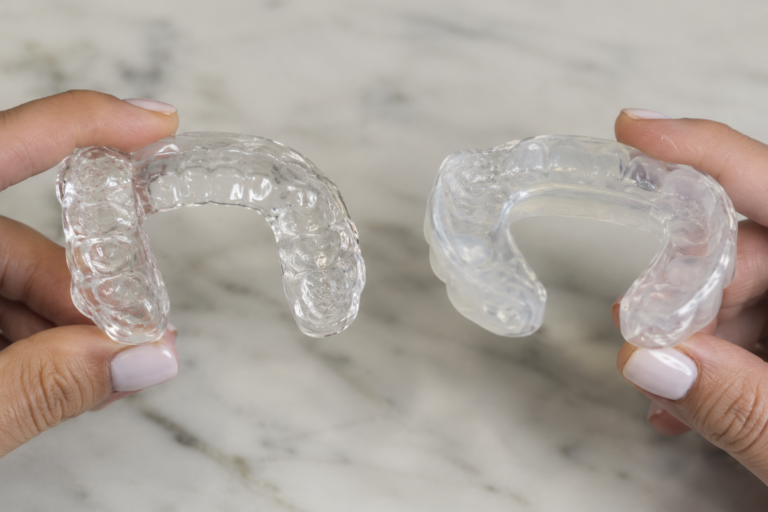
For many people, the first step is a custom night guard or splint. It protects your teeth from grinding and can ease the load on tired muscles. It doesn’t change your bite. NIDCR notes there isn’t much research on whether these appliances relieve jaw pain, so we treat one as a starting point, not a promise.
What we won’t do is grind down your teeth, add crowns, or use braces to stop a click. NIDCR says there isn’t enough evidence that changing the bite treats jaw joint problems, and in some cases it makes them worse.
Will jaw clicking go away on its own?
Often, yes. NIDCR says many jaw joint and muscle problems are short-lived and get better without treatment. A painless click might come and go, or it might stay for years without causing any trouble.
If a new click or ache shows up, Dr. Lowder suggests giving it two or three weeks with softer foods and a relaxed jaw. If it keeps coming back or gets worse, have it checked.
Jaw pain that lasts for months is a different situation. The right person for long-lasting face and jaw pain is often an orofacial pain specialist. That’s a dentist with advanced training in chronic pain of the face and jaw, and NIDCR suggests one for a second opinion. If your exam points that way, we’ll tell you and help you find one.
Why a dentist checks your teeth when your jaw clicks
Your jaw and your teeth take the same force. Clenching and grinding tire out your chewing muscles, and they also wear down, chip, and crack your teeth.
Dr. Tex puts it simply. Most problems in your mouth come from one of two things. Bacteria cause cavities and gum disease. Force causes most of the rest.
So when your jaw clicks, we look at your teeth too. Flat edges, small chips, cracks, and worn-down teeth can all point to clenching or grinding. So can bonding that keeps chipping off, or fillings that keep breaking.
A clicking jaw on its own is usually harmless. A clicking jaw plus worn teeth tells us force is part of the picture. That’s something we can protect your teeth from.
If the joint needs a closer look, 3D imaging shows the bone of the joint from every angle. A regular X-ray is more like one photo taken from the front.
Getting your jaw checked in Sacramento
If your jaw clicks and it hurts, catches, or comes with worn or chipped teeth, it’s worth finding out why. A TMJ evaluation at our Arden-Arcade office looks at your jaw joint, your chewing muscles, and your teeth together.
Dr. Tex does the exam himself. He’ll tell you plainly whether you need treatment, or whether your click is just a click.
Call (916) 972-0788 or find out where your jaw pain is coming from. Our office is at 1733 Professional Dr, Sacramento, CA 95825.
Frequently asked questions On Jaw clicking
Is it normal for your jaw to pop?
Yes, if it doesn’t hurt. The National Institute of Dental and Craniofacial Research says clicking or popping in the jaw joint without pain is common, normal, and doesn’t need treatment. It’s worth an exam if the popping hurts, your jaw catches or locks, or the way your teeth fit together changes.
Why does my jaw pop when I yawn?
Usually because you’re opening wider than normal. Near full opening, the rounded end of your jaw can slide a little past a bump in the joint, and that makes a pop. A pop at the end of a big yawn is normal if it doesn’t hurt. If your jaw ever gets stuck open, get care the same day.
Why did my jaw start clicking all of a sudden?
A new click usually means the small disc in the joint has started slipping out of place. Clenching, grinding, chewing tough food, a hit to the jaw, or opening very wide can all set it off. If it doesn’t hurt, give it two or three weeks. If it hurts or your jaw catches, get it checked.
Can jaw popping be serious?
Usually not. Most jaw popping is painless and harmless. It can be a sign of a jaw joint problem when it comes with pain, a jaw that catches or locks, trouble opening wide, or a change in how your teeth fit together. A jaw that’s stuck open or shut needs same-day care.
Does jaw clicking mean I have TMJ?
Not by itself. TMJ is the name of the jaw joint, and everyone has two of them. A problem with the joint or the chewing muscles is called TMD, or temporomandibular disorder. A painless click alone isn’t a reason to worry. Clicking with pain, stiffness, or locking can be a sign of TMD.
Will my jaw lock if it keeps clicking?
Most clicking jaws never lock. Watch for a jaw that catches for a moment before it clicks, or a click that suddenly stops while your opening gets smaller. Those can mean the disc isn’t slipping back into place anymore. If either one happens, have your jaw checked soon instead of waiting.
Can stress make my jaw click?
It can add to it. Stress often makes people clench their teeth during the day or grind them at night. That tires out the chewing muscles and puts more load on the joint. Mayo Clinic lists stress, anxiety, clenching, and grinding as risk factors for jaw joint problems.
Can a night guard stop jaw clicking?
Not reliably, and that isn’t its main job. A custom night guard protects your teeth from grinding and can ease the load on tired jaw muscles. NIDCR says there isn’t much research on whether these appliances relieve jaw pain. We use one as a first step when grinding or clenching is part of the problem.
Can braces or a bite adjustment fix jaw clicking?
Not on their own. NIDCR says there isn’t enough evidence that changing the bite with braces, crowns, or grinding down teeth treats jaw joint problems, and sometimes it makes them worse. We don’t change your bite to stop a click. We only adjust teeth when the teeth themselves need it, like a filling that sits too high.
Should I see a dentist or a doctor for jaw clicking?
A dentist is a good first stop, because a dentist can check your jaw joint, chewing muscles, and teeth in one visit. See a doctor if you also have ear pain with a fever, numbness, or jaw pain with chest symptoms. For pain that has lasted for months, an orofacial pain specialist may be the right next step.
Sources
National Institute of Dental and Craniofacial Research. TMD (Temporomandibular Disorders). Last reviewed September 2026. https://www.nidcr.nih.gov/health-info/tmd
Mayo Clinic. TMJ disorders: Symptoms and causes. https://www.mayoclinic.org/diseases-conditions/tmj/symptoms-causes/syc-20350941
Cleveland Clinic. Jaw Popping (Clicking): Causes, Symptoms, Treatment. https://my.clevelandclinic.org/health/symptoms/24665-jaw-popping
University of Utah Health, The Scope. Why Your Jaw Pops or Clicks, and When It Signals a Problem. Updated April 9, 2026. https://healthcare.utah.edu/the-scope/health-library/all/2026/04/why-your-jaw-pops-or-clicks-and-when-it-signals-problem
Medical disclaimer: This article is for general information and does not replace an examination and diagnosis by a licensed dentist. Individual results vary.