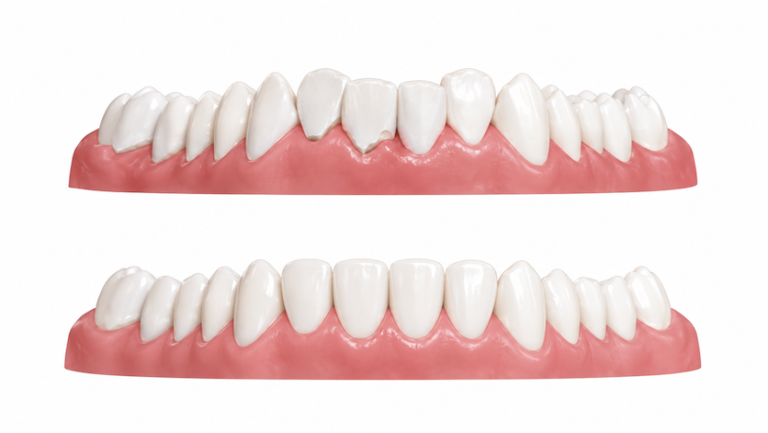

Bonding that chips once is bad luck. Bonding that keeps chipping in the same spot is telling you something, and fixing it again won’t make it stop.
If your front tooth bonding keeps breaking, you’re not alone. A lot of people get a chip fixed, then watch the same corner snap off a few months later. Then it happens again.
Here’s what most people never hear. When bonding fails more than once in the same place, the material usually isn’t the problem. Something is putting more force on that spot than bonding can take, or the bond never had a good surface to grip.
Below, we’ll walk through the three reasons tooth bonding chips, how to tell which one is yours, and when bonding stops being the right fix. We’ll also cover the other ways cosmetic dentistry with bonding can go wrong.
Is it normal for tooth bonding to chip?
Some chipping over time is normal. Composite bonding is a tooth-colored resin, and it’s softer than your natural enamel and softer than porcelain. Cleveland Clinic says bonding usually lasts between three and 10 years before it needs a touch-up or replacement, and it can chip along the way.
So if your tooth bonding chipped once after several years, that’s wear and tear. A quick repair usually takes care of it.
What isn’t normal is bonding that breaks again and again, or bonding that breaks within weeks. That’s a pattern. And a pattern almost always has a cause you can find.
The 3 reasons composite bonding keeps chipping
Bonding fails for three main reasons. Your bite is hitting it too hard, it’s stuck to a surface it can’t grip well, or it’s being asked to do a bigger job than resin can handle. Most repeat failures come from one of these. Some people have two at once.
| Reason | What’s going on | Clues you might notice | What changes it |
|---|---|---|---|
| 1. Your bite is hitting it | Your lower teeth strike the bonded edge when you bite, slide your jaw, or grind | It breaks at the biting edge, often the same corner each time. You clench, grind, or wake up with a sore jaw. | Checking your bite, and a night guard if you grind |
| 2. It can’t grip the tooth | The resin is stuck to dentin, an old filling, or a damp surface instead of clean enamel | The whole piece pops off at once, often leaving a smooth spot behind | Bonding to enamel where possible, or a treatment that doesn’t rely on that grip |
| 3. It’s doing too much | The bonding rebuilds a big part of the tooth, like a long or thin edge | A large piece breaks, often soon after it was placed | A veneer or crown that can carry more load |
1. Your bite is hitting the bonding
This is the most common reason front tooth bonding keeps breaking.
Your top and bottom front teeth touch many times a day. They meet when you bite into food, when you slide your jaw forward, and when you swallow. If your lower teeth hit the bonded edge on each of those moves, the resin takes a small knock over and over. Sooner or later, a corner gives way.
Grinding and clenching make this much worse. Many people grind at night and have no idea. The clues are a sore jaw in the morning, headaches, flat-looking teeth, or a partner who can hear it.
Some bites put the front teeth in harm’s way no matter what. Normally your top front teeth sit a little in front of your bottom ones. If yours meet edge to edge instead, the bonding takes a direct hit every time you close.
Everyday habits add up too. Biting your nails, chewing pens, opening packages with your teeth, and crunching ice all push on the edge in ways bonding wasn’t built for.
For some people, night grinding is tied to breathing problems during sleep. If you grind and you also snore or wake up tired, mention it. A sleep apnea evaluation can rule it in or out.
2. The bonding can’t get a good grip
Bonding sticks best to enamel, the hard outer layer of your tooth. It sticks less well to dentin, the softer layer underneath. It sticks poorly to old fillings and crowns.
That matters a lot when bonding keeps falling off. If a chip went through the enamel, or your enamel is thin from wear, there’s less good surface to hold on to. The same is true when new bonding is placed over old bonding.
Moisture is the other big one. Bonding has to go on a completely dry tooth. Even a little saliva during placement can weaken the bond.
Porcelain and composite bond well to enamel and poorly to dentin. If you’ve already worn through some enamel, there’s less surface for anything to bond to. That’s why cosmetic work placed on worn down teeth tends to come off sooner than the same work on healthy enamel.
The way your bonding fails is a big clue. When the whole piece pops off in one go, the grip let go. When only a corner breaks off, the resin itself cracked, and that points back to your bite.
3. The bonding is doing too big a job
Bonding is great for small fixes, like a small chip, a narrow gap, or a rough edge.
It’s less suited to rebuilding a big part of a tooth. Composite is strong when it’s thick but weak when it’s thin. A long, thin edge added to make a tooth look longer is the most fragile shape you can ask bonding to hold.
So if your bonding replaced a large broken piece, or it was used to lengthen worn teeth, a break is more likely. In that case, the problem isn’t the material. It’s the job the material was given.
What about how it was placed?
Sometimes placement is part of it. Bonding goes on in thin layers. Each layer is hardened with a special light, then the whole thing is shaped and polished. If a step is rushed, the bond can come out weaker.
But if your bonding has failed with more than one dentist, placement probably isn’t the main issue. One of the three reasons above is usually still there.
My composite bonding has chipped. What should I do?
Call your dentist and book a visit. A chipped bonding is usually not an emergency. Until you’re seen, avoid biting hard or crunchy foods with that tooth, and don’t try to file or glue the edge yourself.
A few things make it more urgent. Call sooner if the tooth hurts, feels sensitive to cold, or shows a dark spot where the bonding used to be. Those can mean the tooth itself needs care, not just the bonding. Our emergency dentistry page explains what counts as urgent.
If a piece came off whole, you can bring it along, but it usually can’t be glued back on. New bonding gets placed instead. A short problem-focused exam is the right visit for one tooth like this.
Can chipped composite bonding be repaired?
Yes, chipped composite bonding can usually be repaired. Small chips can often be smoothed and polished, or patched with a little new resin in one visit. If the bonding is old, stained, or broke off in a big piece, it’s usually better to remove it and redo it.
Before any repair, though, ask one question. Why did it break?
If nothing changes, the new bonding goes under the same forces as the last one. A fourth repair on the same corner tends to end the same way as the third.
That’s why we look at your bite before we replace bonding that’s failed more than once. It takes a few extra minutes, and it can save you the next repair. You can read more about how we repair and replace dental bonding on our bonding page.
Bonding that chips once needs a repair. Bonding that keeps chipping needs a reason.
When bonding isn’t the right fix
Bonding is the wrong fix when the same tooth has broken several times, when you grind heavily, or when it’s rebuilding a big part of the tooth. In those cases, a stronger material or treating your bite first usually works better.
– It has failed three or more times in the same spot. At that point, the pattern is the diagnosis. Your bite needs a look before anything else goes on that tooth.
– You grind or clench, and your teeth are already worn. Bonding on worn teeth tends to keep breaking until the grinding is under control.
– It’s rebuilding a large or long edge. Porcelain veneers or dental crowns handle more force than resin in that spot.
– Your enamel is thin or mostly gone. Porcelain needs enamel to bond to as well, so the better answer may be a crown, or treating the cause of the wear first.
None of this makes bonding a bad treatment. It’s a great one in the right spot. It just isn’t built for every job.
How long should front tooth bonding last?
Front tooth bonding usually lasts three to 10 years, based on Cleveland Clinic’s range. Where yours lands in that range depends mostly on your bite, your habits, and how much of the tooth the bonding covers.
Bonding on the biting edge of a front tooth tends to need repair sooner, because that edge does the most work. Bonding that closes a small gap or covers a stain on the front of the tooth often lasts longer.
If yours lasted only a few months, that’s well outside the normal range. It’s worth finding out why before it’s redone.
Other ways composite bonding can go wrong
Composite bonding gone wrong doesn’t always mean a chip. Here are the other signs of bad composite bonding, and what usually causes each one.
| Problem | What it looks like | What usually causes it |
|---|---|---|
| Staining | The bonding looks yellow or darker than the teeth around it | Coffee, tea, red wine, and smoking. Resin picks up stain more easily than enamel or porcelain. |
| A dark line at the edge | A thin brown or gray line where the bonding meets the tooth | Stain getting into a tiny gap at the edge. Sometimes it’s a sign of decay underneath. |
| Color no longer matches | Your teeth look whiter than the bonding | Teeth were whitened after the bonding went on. Whitening doesn’t change the color of resin. |
| Looks bulky | Teeth look thick, too wide, or stick out | Too much material was added, often to cover a gap or chip in one step |
| Sore or puffy gums | Gums next to the bonding bleed or look red | A rough or overhanging edge at the gum line that traps plaque |
Teeth can also get cavities under bonding if the edge starts to leak. That’s one reason a regular exam matters even when nothing hurts. Decay caught early is small and simple to treat.
Planning to brighten your smile? Do your teeth whitening before bonding, not after. That way your bonding gets matched to your new shade.
How to make your next bonding last longer
Most of what makes bonding last is in your hands, or your dentist’s. A few habits make a real difference.
– Wear a night guard if you grind. A custom guard takes the force instead of your bonding.
– Stop using your front teeth as tools. That means no nails, pens, ice, or opening packages.
– Bite hard foods with your side teeth. Think apples, crusty bread, and corn on the cob.
– Keep up with your cleanings. Polishing at each visit keeps bonding smooth and slows down staining.
Ask for a bite check before a repeat repair. If the bonding has broken before, find the cause first.
What does it cost to fix bonding that keeps breaking?
The cost depends on what’s causing the problem more than on the repair itself. A small chip that just needs smoothing or a quick patch costs much less than redoing all the bonding on a tooth. If your bite needs work, or the tooth needs a veneer or crown instead, those are separate costs.
Over time, the cheapest option is the one that stops the repeat repairs. Our new patients page covers payment and financing options.
Frequently asked questions
Is it normal for bonding to chip?
Some chipping over time is normal. Composite bonding is softer than enamel, and Cleveland Clinic says it usually lasts three to 10 years before it needs a touch-up or replacement. Bonding that chips again and again, or within a few months, isn’t normal. That pattern usually points to a bite or grip problem.
Why does my tooth bonding keep falling off?
Bonding that falls off in one piece usually couldn’t grip the tooth well. That happens when it’s bonded to dentin, an old filling, or a damp surface instead of clean enamel. If only a corner breaks off, the resin cracked instead. That usually points to bite force from grinding or how your teeth meet.
Can chipped composite bonding be repaired?
Yes. Small chips can often be smoothed and polished, or patched with new resin in one visit. Older, stained, or badly broken bonding is usually removed and redone. If the same spot keeps breaking, have your bite checked first, or the repair is likely to fail the same way.
How long should front tooth bonding last?
Front tooth bonding usually lasts three to 10 years. Bonding on the biting edge tends to need repair sooner, because that edge takes the most force. Bonding on the front surface, like a small gap closure, often lasts longer. Bonding that breaks within a few months is outside the normal range.
Is chipped bonding an emergency?
Usually not. Book a regular visit, avoid biting hard foods with that tooth, and leave the edge alone. Call sooner if the tooth hurts, is sensitive to cold, or shows a dark spot where the bonding was. Those can mean the tooth itself needs attention, not just the bonding.
Can teeth rot under bonding?
Yes, they can. If the edge of the bonding leaks, bacteria can get under it and cause decay. A dark line around the edge can be an early sign. Regular checkups and X-rays help catch decay under bonding while it’s still small and simple to treat.
What are the signs of bad composite bonding?
Common signs are chipping that keeps coming back, bonding that pops off, staining or a dark line at the edge, and a color that no longer matches. Teeth that look bulky, or gums that are sore or bleed next to the bonding, are signs too. Any of these is worth showing your dentist.
Does composite bonding stain?
Yes. Composite resin picks up stain more easily than natural enamel or porcelain. Coffee, tea, red wine, and smoking are the usual causes. Polishing at your cleanings helps, but whitening won’t lighten it. Badly stained bonding can be polished, resurfaced, or replaced.
Will teeth whitening change the color of my bonding?
No. Whitening works on natural teeth, not on composite resin. If you whiten after getting bonding, your teeth can end up lighter than the bonding. The usual fix is to whiten first, then have your bonding matched to your new shade or replaced.
Should I get veneers instead of bonding?
Sometimes. Veneers handle more force and resist stains better, so they suit teeth where bonding keeps breaking or covers a large area. They also cost more and need healthy enamel to bond to. If grinding is the cause, it needs to be managed with either option.
The bottom line
Tooth bonding that chips once is normal wear. Bonding that keeps chipping is a sign that something is working against it.
Most of the time, that something is your bite, a weak grip on the tooth, or a job that’s too big for resin. Fixing the bonding again without finding the cause usually means fixing it again next year.
If your bonding has broken more than once, the most useful next step isn’t another repair. It’s finding out why. If you’re in the Sacramento area, book a visit and we’ll look at the tooth, your bite, and what’s been breaking it.
Medical disclaimer: This article is for general information and does not replace an examination and diagnosis by a licensed dentist. Individual results vary.