

Teeth wear down in three different ways. Which one is happening to you decides whether bonding, veneers, crowns, or a change to your bite is the right fix. Getting that backwards is how expensive dental work fails twice.
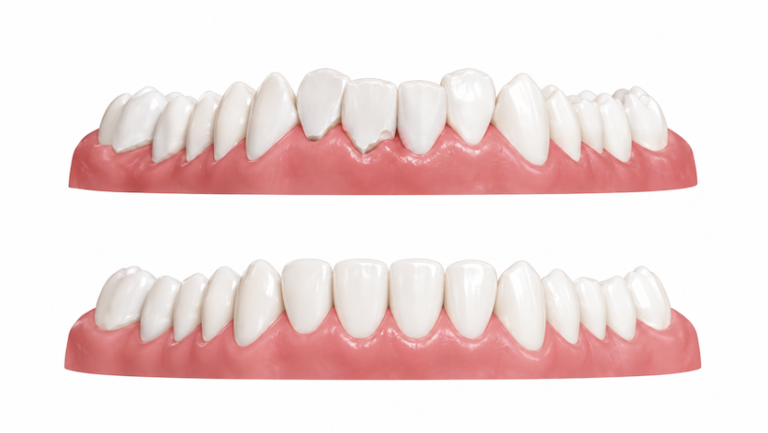
Worn down teeth show up in small ways first. Your front teeth look shorter than they used to. The edges look thin, almost see-through. Your back teeth feel flat when your tongue runs across them.
Most articles hand you a list of treatments and stop there. Bonding, veneers, crowns, take your pick. That list won’t help you much until you know what wore the teeth down to begin with.
Teeth wear three different ways, and each one has a different fix. Here’s how to tell which is happening to you, and where veneers really fit.
Why are my teeth wearing down?
Teeth wear down for three reasons. Grinding and clenching wear tooth against tooth, which dentists call attrition. Acid dissolves the enamel surface, which is erosion. Mechanical force at the gum line wears a notch into the tooth, which is abrasion or abfraction. Most worn teeth involve more than one of the three. The pattern of wear is what tells a dentist which cause is doing the damage, and that’s what decides whether the fix is bonding, veneers, crowns, or a change to the bite itself.
Some wear is normal. Your teeth touch thousands of times a day, and enamel gives up a little of itself each time. That happens slowly enough that most people never notice it.
What isn’t normal is wear you can see in the mirror. Shorter teeth, thin edges, flat spots, a notch at the gum line. Changes like that mean something is working faster than your teeth can keep up with. Finding out what changes the whole treatment plan.
The three ways teeth wear down, and why the difference decides your treatment
The three causes leave different marks. That’s useful, because it means you can usually narrow it down yourself before you ever sit in a chair.
Here’s what separates them:
| Cause | What it is | What it looks like | Common sources | What actually fixes it |
| Attrition | Tooth wearing against tooth | Flat, shiny worn spots on the biting surfaces that match up between upper and lower teeth. Front teeth all the same shortened length. | Grinding, clenching, an uneven bite, missing back teeth pushing load forward | Manage the force first, then restore. Bonding for light wear. Onlays or crowns for heavy wear. |
| Erosion | Acid dissolving the enamel surface | Thin, glassy, see-through edges. Shallow cupped hollows on chewing surfaces. Old fillings sitting higher than the tooth around them. | Reflux, citrus, sparkling water, sports drinks, wine, repeated vomiting, some medications | Find and remove the acid source first. Restore only after that, or the new work erodes too. |
| Abrasion and abfraction | Wear and flexing at the gum line | A notch or wedge cut into the tooth right where it meets the gum, often on canines and premolars. Cold sensitivity. | Hard horizontal brushing with a stiff brush, plus bite forces flexing the tooth at its neck | Change the brushing technique. Address the bite load. Then fill the notch. Filling it alone doesn’t hold. |
Attrition, the grinding and clenching pattern
Attrition is tooth wearing against tooth. It’s the most common cause of visible wear, and grinding or clenching is usually what’s driving it.
You can spot attrition by how evenly it lines up. The worn areas are flat and shiny, and they match. Your upper and lower teeth are grinding against each other, so the wear on one mirrors the wear on the other. Bring your teeth together and the flat spots meet.
Lower front teeth often go first. They’re thinner and smaller than the uppers, and in many bites they take the worst of the sliding. If your bottom front teeth look shorter than they do in an old photo, attrition is the likely reason.
Here’s the part most articles skip. Grinding isn’t a habit you picked up. It’s a symptom of something.
Two things drive it in most people. The first is a bite that doesn’t fit together well, so the jaw keeps hunting for a comfortable spot. The second is an airway that gets restricted while you sleep, which can trigger clenching at night without you ever knowing. Both come up again further down, because that’s where treatment actually starts.
Erosion, and why thinning front teeth are usually this
Front teeth that look thin, glassy, or see-through at the edges are usually eroding rather than grinding down. Acid from reflux, frequent citrus, sparkling water, sports drinks, or vomiting dissolves enamel from the surface. Enamel is what gives a tooth its solid, opaque look, so as it thins the darker dentin underneath starts to show through and the edge turns translucent. Erosion is treated by finding and removing the acid source first. Restoring the teeth before that happens means the new work wears down the same way.
The see-through look confuses people, so it’s worth explaining. A tooth has two main layers. Enamel is the hard white shell on the outside. Dentin is the softer, yellower layer underneath it.
Enamel is what makes a tooth look solid. Thin it out and light passes straight through the edge. That’s why an eroding front tooth looks glassy at the tip while the rest of it still looks normal.
Acid does this, not force. The usual sources are easy to name. Reflux, citrus, sparkling water, sports drinks, wine, and repeated vomiting. Reflux deserves a flag, because plenty of people have it at night and never feel heartburn.
Order of treatment matters more here than anywhere else. Bonding erodes. Porcelain edges erode. If the acid is still coming, new dental work wears out on the same schedule your enamel did. Find the source first.
Abrasion and abfraction, the notch at the gum line
A notch cut into a tooth right at the gum line is either abrasion or abfraction. They look similar and often happen together, but they aren’t the same thing.
Abrasion is wear from the outside. Usually that means a stiff toothbrush and a hard side-to-side scrub, repeated for years. It shows up worst on the teeth your dominant hand reaches hardest, which is why one side is often worse than the other.
Abfraction works differently. Heavy bite forces flex the tooth slightly at its neck, and that flexing cracks the enamel where the tooth is thinnest. The result is a sharp wedge shape rather than a rounded scoop.
Dentists don’t fully agree on how much of any given notch comes from brushing and how much comes from flexing. That’s an honest limit of what the research shows right now. In practice, most notches involve both.
What matters for you is what happens next. A filling placed in that notch, with nothing else changed, tends to come loose or wear out underneath. The brushing technique has to change. If bite forces are part of it, those have to be handled too. Otherwise you’re filling the same notch again in a few years.
How to tell how far the wear has gone
How much tooth you’ve lost matters as much as what caused it. Wear moves through stages, and each stage opens or closes certain options.
| Stage | What you’d notice | What it means for treatment |
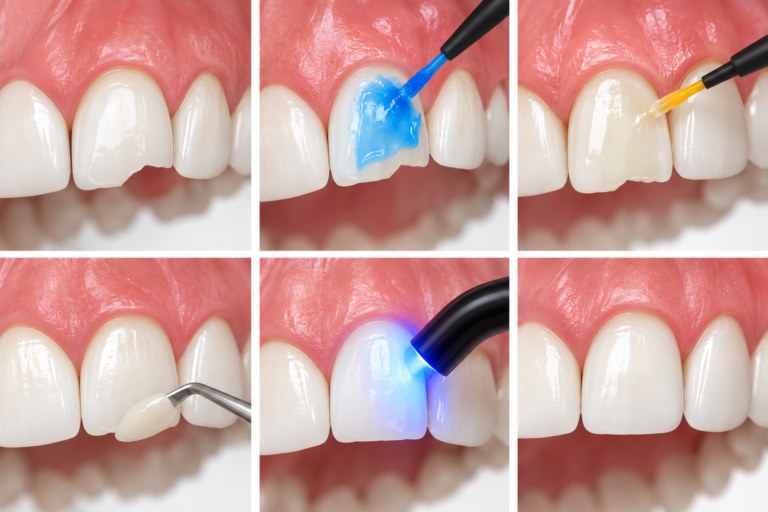
| Enamel only | Slightly flattened edges, mild sensitivity, teeth that look duller than they used to | Composite bonding usually handles it. This is the cheapest point to step in, and often the right one. |
| Into the dentin | Yellow or brown patches showing through the biting edges, real cold sensitivity, cupped hollows on back teeth | Bonding, veneers, or onlays, depending on where the wear sits and how much enamel is left to bond to. |
| Close to the pulp | Sharp pain, dark spots in the center of a worn surface, teeth that are visibly shorter | Full coverage crowns, and sometimes root canal treatment before restoring. Not a veneer case. |
| Bite height lost | A face that looks shorter, the chin sitting closer to the nose, deep folds at the corners of the mouth, teeth much shorter than in old photos | The bite height has to be rebuilt before anything gets restored. That’s a full mouth rehabilitation, not cosmetic dentistry. |
The first three stages can usually be handled one tooth at a time. The fourth can’t. Once enough height is gone across enough teeth, the bite itself has changed, and there’s no physical room to place a restoration until that height gets rebuilt. That’s a different kind of case entirely.
Can worn down teeth be fixed?
Worn down teeth can be fixed, and the right fix depends on how much tooth structure is gone. Light wear that stays inside the enamel is usually restored with composite bonding. Moderate wear that has reached the dentin is restored with porcelain veneers or onlays. Severe wear that has shortened the teeth enough to close the bite needs the bite height rebuilt first, which is a full mouth rehabilitation rather than a cosmetic case. In every category the cause of the wear has to be controlled, or the new restorations wear down the same way the teeth did.
The stage you’re in decides the answer more than anything else. Light wear is a small, affordable fix. Severe wear is a large, planned one. That gap is exactly why an honest answer needs an exam behind it.
One rule holds across all of them. The cause has to be under control. A restoration doesn’t change what wore the tooth down. If the grinding, the acid, or the scrubbing keeps going, the new work goes the same way the enamel did.
Do veneers work on worn, chipped, and thinning teeth?
Veneers work on worn teeth under three conditions: enough enamel remains to bond to, the wear hasn’t shortened the teeth enough to change the bite, and the cause of the wear is under control. Porcelain veneers bond most predictably to enamel, and a worn tooth has lost enamel by definition, so how much is left is the first thing a dentist checks. When wear is severe or grinding is unmanaged, full coverage crowns or onlays hold up better, because a veneer covers the front of a tooth and does nothing to absorb the force that wore it down.
When veneers are the right answer
Veneers fit a specific set of cases well:
– Chipped or uneven front edges, where the tooth underneath is otherwise sound. There’s plenty of enamel left, and a veneer restores the shape without removing much tooth.
– Mild to moderate wear, where the enamel layer is thinner but still there. The bond has something reliable to hold onto.
– Erosion that’s been diagnosed and controlled. Once the acid source is handled, porcelain holds up well.
– Shape and color concerns riding alongside light wear. This is the case most people picture when they think veneers, and it’s a good fit.
The same thread runs through all four. There’s enamel to bond to, and whatever caused the wear has already been dealt with.
When veneers are the wrong answer
Veneers are a poor choice in four situations, and it’s worth being direct about them.
– Heavy attrition, where enamel is gone across the biting surfaces. There isn’t a reliable bonding surface left.
– Active, untreated grinding. The force that flattened natural enamel will find porcelain too.
– Uncontrolled reflux or dietary acid. New edges erode on the same timeline the old enamel did.
– Wear severe enough that bite height is gone. There’s physically no room for a veneer until that height is rebuilt.
In those cases the answer is usually full coverage crowns, onlays, or a planned rehabilitation that rebuilds the bite first.
Here’s the uncomfortable version. If someone quotes you a full set of veneers on heavily worn teeth without evaluating your bite, you’re being offered a cosmetic answer to a mechanical problem. Ask what’s causing the wear before you agree to cover it up.
Why veneers fail on ground down teeth
Two things break veneers on worn teeth, and both are worth understanding before you decide.
The first is adhesion. Porcelain veneers bond most predictably to enamel. The bond to dentin, that softer layer underneath, is less reliable. A worn tooth has less enamel by definition. So the less enamel you have left, the weaker the grip and the higher the chance a veneer comes loose.
The second is force. A veneer is a facing on the front of a tooth. It doesn’t spread bite load around, and it doesn’t stop you clenching at three in the morning. Whatever flattened your natural enamel is still there, and it’s still working.
Put those together and the rule is simple. If the grinding hasn’t been addressed, the veneer is on a countdown.
| A veneer covers a tooth. It doesn’t stop the force that wore the tooth down. If the grinding, the bite, or the acid hasn’t been dealt with, the restoration is on the same countdown the natural tooth was. |
Treatment options for worn teeth, compared
Each option below solves a different problem. The right one depends on your stage of wear and what caused it, not on which one sounds best.
| Option | Best for | The honest limitation |
| Composite bonding | Light wear, small chips, worn edges with enamel still present | Stains and chips more easily than porcelain. Often the right first step precisely because it’s affordable and reversible. |
| Porcelain veneers | Moderate front-tooth wear and chipping, with enamel to bond to and the cause controlled | Needs enamel. Doesn’t protect against bite force. Not the right call on a heavily worn mouth. |
| Onlays | Worn back teeth where the biting surface is gone but the walls of the tooth are sound | Keeps more of your tooth than a crown does, which is the point. Still needs enough solid structure to bond to. |
| Full coverage crowns | Heavy wear, teeth close to the nerve, grinding that hasn’t been managed | Removes the most tooth structure. Worth it when the coverage is genuinely needed. |
| Orthodontics or bite adjustment | Wear driven by how the teeth meet rather than by force alone | Doesn’t rebuild lost tooth structure. It stops the cause so the restorations last. |
| Full mouth rehabilitation | Severe wear where bite height has been lost | The largest option in scope and cost. Also the only one that works once bite height is gone. |
| Night guard | Anyone actively grinding, alongside any of the above | Protects what’s left. Doesn’t restore anything, and doesn’t treat what’s making you clench. |
Most real cases mix two or three of these. A patient with moderate front-tooth wear and flattened molars might get bonding up front, onlays in back, and a guard to protect all of it.
Notice what the last row does and doesn’t do. A guard is protection, not treatment. It’s a good idea for almost anyone who grinds, and it still leaves the underlying question unanswered.
What does it cost to fix worn down teeth?
Two things drive the cost of fixing worn teeth, and neither one is the material.
The first is how many teeth need work. Restoring four front teeth and restoring a full arch are different projects at different prices, even when the porcelain is identical.
The second is the stage of wear. Bonding a thin edge is one short appointment. Rebuilding bite height across both jaws is months of planned treatment. Your stage decides which of those you’re looking at.
There’s a third line item most people don’t expect, and it comes first. A bite evaluation and diagnostic workup have to happen before anyone can quote a plan honestly. A practice that prices a full veneer case without one is quoting a number it can’t stand behind, because it doesn’t yet know whether veneers are the right restoration.
On insurance: most dental plans treat wear repair as cosmetic and cover little of it. Coverage tends to improve when there’s documented function loss or structural damage. Ask your plan what it counts as restorative versus cosmetic before you build a plan around it.
How to stop your teeth wearing down any further
Whatever you decide to restore, these six steps slow the damage down.
1. Get the wear pattern diagnosed before you restore anything. The three causes have three different treatments, and guessing wrong means paying twice.
2. If it’s erosion, deal with the acid source first. Reflux and dietary acid will wear down new restorations on the same timeline they wore down your enamel.
3. Switch to a soft brush and stop scrubbing sideways at the gum line. Those notches get cut by technique, not by plaque.
4. If you grind, wear the guard your dentist makes for you every night. A guard is the only thing standing between the force and whatever tooth you have left.
5. Have your bite and your airway evaluated instead of accepting a guard and stopping there. A guard protects teeth without treating what’s making you clench.
6. Restore in the right order, worst first, structure before appearance. A tooth that reaches the nerve stops being a cosmetic decision and becomes an urgent one.
Why the cause has to be treated before the teeth are
Restoring worn teeth without diagnosing why they wore is the most common reason expensive dental work fails twice. The restoration is new. The force, the acid, or the technique that destroyed the original is unchanged.
That’s why a comprehensive exam here looks at four things before anyone talks about materials.
| What gets examined | What it tells us about your wear |
| How your teeth meet | Whether the wear is driven by an uneven bite, by missing back teeth pushing load onto the front, or by force alone. This decides whether restoring is enough or whether the bite has to change. |
| Your joints and muscles | Whether the grinding is producing joint symptoms and morning jaw tension, and whether the muscle pattern points to clenching at night rather than during the day. |
| Your airway | Whether the clenching is being triggered by disrupted breathing during sleep. A cosmetic consultation never looks for this, and it changes the plan when it’s there. |
| Your bite height | Whether wear has shortened your teeth enough to lose vertical height. This one measurement decides whether your case is cosmetic or a rehabilitation, and it has to be answered before any restoration is designed. |
Getting those answers takes 3D imaging, a bite and TMJ evaluation, and an airway assessment. Appointments here are unhurried on purpose, because you should understand your own wear pattern before you agree to treat it.
The practice is fee-for-service and independent of insurance contracts. That matters here, because sometimes the honest recommendation is to treat the cause now and restore in six months, and no coverage tier gets a vote in that.
If your teeth are wearing down and nobody has explained why, that’s the appointment to book.
Frequently asked questions
Can worn down teeth be fixed?
Yes. The right fix depends on how much tooth structure is gone. Light wear inside the enamel is usually restored with bonding, moderate wear with veneers or onlays, and severe wear that has shortened the bite with a full mouth rehabilitation. In every case the cause has to be controlled first.
Can veneers fix worn down teeth?
Sometimes. Veneers work when enough enamel remains to bond to, the wear hasn’t changed your bite height, and the cause is under control. Porcelain bonds most predictably to enamel, and worn teeth have lost enamel by definition, so how much is left is the first thing we check.
Can you get veneers if you grind your teeth?
Only after the grinding is managed. Unmanaged grinding is one of the most common reasons veneers chip or come loose, because a veneer doesn’t absorb bite force. Expect a night guard as part of the plan, and expect the bite itself to be evaluated before anything gets bonded on.
Why are my front teeth thinning at the bottom?
That’s usually erosion, not grinding. Acid dissolves enamel from the surface, and enamel is what makes a tooth look solid, so the edge turns thin and see-through as it wears away. Reflux is a common cause and many people have it at night without ever feeling heartburn.
Why are my bottom front teeth wearing down?
Usually attrition, meaning tooth grinding against tooth. Lower front teeth are thinner than the uppers, and in many bites they take the worst of the sliding. Have the upper teeth checked at the same time, because attrition is always mutual. Whatever wore the bottoms is wearing something on top too.
Can worn tooth enamel grow back?
No. Enamel has no living cells, so it can’t regenerate. Very early softening can be remineralized with fluoride, which hardens the surface again but doesn’t replace lost thickness. Once a tooth is visibly shorter or thinner, that structure only comes back with a restoration.
Will a night guard fix teeth that are already worn?
No. A guard protects what’s left and helps prevent further wear. It doesn’t restore lost structure and it doesn’t treat what’s causing the clenching. Think of it as protection while the actual cause gets sorted out.
What’s the difference between attrition, erosion, and abrasion?
Attrition is tooth wearing against tooth, usually from grinding, and it leaves flat matching worn spots. Erosion is acid dissolving the enamel surface, and it leaves thin, glassy edges and cupped hollows. Abrasion is external mechanical wear, usually hard brushing, and it leaves a notch at the gum line. Abfraction is a fourth term you’ll see, describing a wedge-shaped notch caused by the tooth flexing under bite force.
How fast do teeth wear down from grinding?
It varies enormously between people, and there’s no single number that applies to everyone. What’s more useful is the comparison. Normal daily use wears enamel slowly enough that most people never notice. Active grinding can produce visible change in a few years.
What does it mean when your teeth are worn down?
It means tooth structure has been lost, and enamel doesn’t grow back. The loss comes from grinding, acid, or mechanical wear at the gum line. Worn teeth aren’t an emergency on their own, but they are a sign that something is actively working on them.
The bottom line
Worn down teeth come from three causes, and the three have different fixes. Grinding, acid, and mechanical wear at the gum line all shorten teeth, but they don’t respond to the same treatment.
Whether veneers work for you comes down to two questions. How much enamel is left to bond to, and has the force or acid been dealt with. If the answer to either one is no, the right restoration is something else.
None of that can be decided from a photo or a price list. The treatment plan starts with knowing why your teeth wore down, which is a diagnosis, not a quote.
Worn teeth are a record of something that happened. Fixing the record without fixing what wrote it just starts the clock again.
Medical disclaimer: This article is for general information and does not replace an examination and diagnosis by a licensed dentist. Individual results vary.