

A gap between the front teeth has five possible causes. Which one you have decides whether the fix is bonding, veneers, braces, or treating something else first.
Two kinds of people look up a gap between front teeth. Some have had theirs since their adult teeth came in, and they’re deciding whether to close it. Others noticed one recently and want to know if something’s wrong.
Those are different situations with different answers, usually involving cosmetic dentistry solutions. A gap you’ve always had is usually just how your teeth and jaw are proportioned. A gap that showed up last year means something moved, and teeth don’t move without a reason.
Here’s what causes each kind, how to tell which one you have, and the four ways to close it.
Why do I have a gap between my front teeth?
A gap between the front teeth is called a diastema. Five things cause it. The teeth can be narrower than the jaw they sit in, a thick band of tissue called the labial frenum can sit between them, gum disease can loosen the teeth enough to let them drift, a missing tooth elsewhere can let the rest spread, or the teeth can relapse after braces when a retainer stops being worn. The cause decides the fix. Bonding and veneers make the teeth wider, orthodontics moves them together, and a gap caused by gum disease has to be treated before anything is closed.
Most articles hand you a list of causes, then a separate list of treatments, and leave you to work out which line in the second list belongs to your line in the first. That’s the part we’re going to connect.
It matters more than it sounds. Two people can have gaps that look identical in a photo and need completely different treatment, because the reason the space is there isn’t the same.
The five causes, and what each one means for treatment
Each cause leaves its own clues. You can usually narrow yours down in a mirror before you ever sit in a chair.
| Cause | What it is | How you can tell | What it means for treatment |
| Narrow teeth | Your teeth are smaller than the jaw they sit in, so there’s space left over | You’ve had it since your adult teeth came in. It often runs in the family. The gap hasn’t changed in years. | A cosmetic choice, not a health problem. Bonding or veneers if you want it closed. Leaving it alone is a fine answer too. |
| A low labial frenum | The band of tissue from your upper lip to your gum attaches low, between the two front teeth | Lift your upper lip and look. If the band runs down between the teeth instead of stopping above them, it’s likely part of it. | The band usually needs releasing before or alongside closure, or the gap tends to open back up. |
| Gum disease and bone loss | The bone and gum holding your teeth pull back, and the teeth drift into the space | The gap is new or getting wider. Gums bleed, look puffy, or have receded. Teeth may feel slightly loose. | Treat the gum disease first. Closing the space over active disease just covers something that’s still moving. |
| Drift after a missing tooth | A tooth is missing somewhere else, and the rest slowly spread into the space | There’s a missing tooth somewhere in your mouth, sometimes years old and near the back where it’s easy to forget. | Replace the missing tooth or the drift keeps going. Closing the front gap alone treats the symptom. |
| Relapse after braces | Teeth drift back toward where they started once retainer wear stops | You had braces or aligners, and the gap is returning to roughly where it used to be. | Orthodontic retreatment plus a retainer plan. Bonding over a gap that’s still moving tends to be temporary. |
Your teeth are narrower than your jaw
This is the most common reason, and the most harmless one.
Jaw size and tooth size are inherited separately, so they don’t always match up. If your teeth are a little narrow for the arch they sit in, that leftover space has to go somewhere, and it usually shows up between the two front teeth.
A gap like this doesn’t damage anything. It doesn’t get worse. It doesn’t make you more likely to lose teeth. If you like how it looks, or you just don’t think about it, there’s nothing here that needs fixing.
If you don’t like it, closing it is a straightforward cosmetic decision. Just know that’s what it is, and nobody should be telling you otherwise.
A low labial frenum
Your labial frenum is the band of tissue that runs from the inside of your upper lip down to your gum. Everyone has one. The question is where it attaches.
Lift your upper lip and have a look in the mirror. In most people the band stops above the teeth. In some people it runs all the way down and attaches between the two front teeth, and that tissue physically keeps them apart.
You’ll see the lingual frenum mentioned online in this context, sometimes even by dental professionals. That’s a different structure, the one under your tongue that’s linked to tongue tie. The band between your upper front teeth is the labial frenum.
If a low frenum is part of your gap, releasing it is a short procedure called a frenectomy. It usually happens before or alongside closing the space, because a gap closed with that band still in place has a habit of reopening.
Gum disease and bone loss
This is the cause that changes what kind of appointment you need.
Your teeth aren’t set in your jaw like fence posts in concrete. They’re held by bone and by fibres, and both can be destroyed by gum disease. When enough support is gone, teeth start to move. Front teeth often flare outward and apart, which opens a gap that wasn’t there before.
The clue is timing. A gap that’s new, or one that’s visibly wider than it was a year ago, points here. Look for the other signs too: gums that bleed when you brush, gums that look puffy or have pulled back from the teeth, or a tooth that feels slightly loose when you press it.
The treatment order isn’t flexible. Gum disease gets treated first, usually with a deep cleaning below the gum line. The teeth get stable. Only then does anyone talk about closing the space.
Closing it earlier means bonding over a condition that’s still active, and the teeth can keep moving underneath the new work.
A missing tooth somewhere else
This one surprises people, because the cause is nowhere near the gap.
Teeth lean and drift toward empty space. Lose a molar and the tooth behind it tips forward, the tooth in front slides back, and that small shift passes along the arch like a row of books when you take one out. Months or years later, it shows up as a space between your front teeth.
So if you’ve got a gap at the front, it’s worth counting your back teeth. A molar pulled six years ago and never replaced is a common answer.
Filling that space stops the drift. A dental bridge or a dental implant does that job. Close the front gap without replacing the missing tooth and you’ve treated the part you can see while the cause carries on.
Relapse after braces
If you had braces or aligners and a gap is creeping back, that’s orthodontic relapse.
Teeth have a memory. The fibres around them stay under tension for years after treatment, and given the chance they’ll pull the teeth back toward where they started. A retainer is what stops that.
Here’s the part nobody enjoys hearing. Retainers aren’t a phase you finish. They’re maintenance, and most relapse traces straight back to stopping them.
The fix is usually orthodontic retreatment with a proper retention plan afterward. Bonding over a gap that’s still actively moving is a patch, not a repair.
Why did a gap suddenly appear between my front teeth?
A gap that opens in adulthood is not the same as a gap someone has had since childhood. Teeth do not move without a reason. In adults the usual reasons are gum disease loosening the support around the teeth, bone loss letting them drift, a missing tooth elsewhere in the mouth letting the remaining teeth spread, or orthodontic relapse after retainer wear stopped. A new gap is worth an examination rather than a cosmetic quote, because in adults it is more often a sign of something changing than a purely cosmetic issue.
Teeth do shift slowly throughout life, and a very small amount of movement over decades is normal. That’s not what we’re talking about here. We mean a change you noticed, in a photo or in the mirror, over months rather than decades.
Run through the four in order. Gum disease is the most common and the most important to catch early, because bone that’s been lost doesn’t grow back on its own. Drift from a missing tooth is next, and it’s the one people rarely connect. Relapse applies if you’ve had orthodontic work. Less often, a long-standing habit like tongue thrusting or nail biting does it over time.
None of this is an emergency. But it is information, and covering it up costs you the chance to act on it.
If your gap is new, the appointment to book is an oral exam, not a cosmetic consultation. Those are different visits with different goals.
A gap you’ve had since childhood is a decision. A gap that opened last year is a question. The second one needs an answer before it needs a cosmetic quote.
How do you close a gap between front teeth?
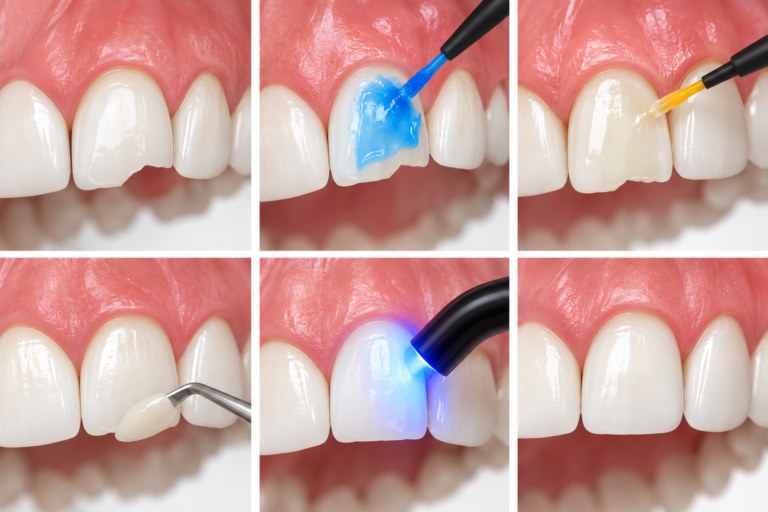
Four treatments close a gap between the front teeth. Composite bonding adds tooth-coloured material to the sides of the teeth, usually in one visit. Porcelain veneers cover the front of the teeth and suit wider gaps or gaps alongside other shape concerns. Orthodontics, with braces or clear aligners, moves the teeth together instead of making them wider. Replacing a missing tooth stops the drift that opened the space. Bonding and veneers make teeth wider, so the size of the gap decides whether the result will still look like a natural tooth.
| Option | What it does | What it doesn’t do | Best for |
|---|---|---|---|
| Composite bonding | Adds tooth-coloured material to the sides of the teeth to make them wider, usually in one visit | Doesn’t move teeth, and doesn’t stop whatever opened the gap | Small to moderate gaps where the teeth are otherwise healthy. The most affordable option and the easiest to undo. |
| Porcelain veneers | Covers the front of the teeth with a thin porcelain facing, fixing width and shape at the same time | Doesn’t move teeth. Needs enamel to bond to. | Wider gaps, or a gap alongside shape, colour or edge concerns on the same teeth. |
| Braces or clear aligners | Moves the teeth together, so they keep their natural width | Doesn’t change tooth shape, and needs a retainer afterward or the gap can come back | Larger gaps, and any case where making the teeth wider would leave them looking out of proportion. |
| Replacing a missing tooth | Fills the space that started the drift, with a bridge or an implant | Doesn’t close the front gap by itself. It stops the cause. | Any case where a missing tooth elsewhere is letting the remaining teeth spread. |
There’s an honest limit on the first two, and it’s the thing to understand before you pick.
Bonding and veneers don’t move teeth. They make teeth wider. Closing a four millimetre gap with bonding means adding about two millimetres to each front tooth. Do that and the teeth get broader. Past a certain point they stop looking like front teeth and start looking like two wide tiles, and no amount of skill hides it.
That’s where braces or aligners become the better answer even though they take longer. Your teeth stay the size they already are, and the space closes because they moved.
Plenty of real cases use two options together. Aligners close most of the space, then a small amount of bonding evens out the shape at the end. That combination often looks better than either one on its own.
When closing the gap is the wrong first move
Closing a gap is the wrong first move when the gap is a symptom. If gum disease or bone loss opened the space, bonding over it covers a problem that is still progressing, and the teeth can keep moving underneath the new work. If a missing tooth let the others drift, closing one gap leaves the rest of the drift in place. If a low labial frenum sits between the teeth, closing the space without releasing it makes the gap more likely to reopen. In each case the cause is treated first and the cosmetic work comes after.
Four situations, and it’s worth being blunt about each one:
– Your gums bleed or have pulled back. Get the gum disease treated before anything is bonded on. The teeth have to be stable first.
– You’re missing a tooth somewhere else. Replace it, or the drift that opened this gap keeps going and opens others.
– The band of tissue sits low between your front teeth. It usually gets released, or the gap comes back.
– You had braces and the gap is returning. The teeth are still moving. Bonding a moving target doesn’t hold.
None of that means you can’t have the gap closed. It means there’s a step before it. Skip that step and you pay twice, once for the work and once for redoing it.
If someone quotes you a cosmetic price for a gap that appeared recently, without examining why it appeared, that’s the moment to slow down and ask.
What does it cost to close a gap between front teeth?
Two things drive the price, and neither one is the material.
The first is how many teeth are involved. Closing one space between two front teeth and reshaping six teeth to balance a smile are different jobs at different prices.
The second is whether the cause needs treating first. Gum treatment, a frenectomy, or replacing a missing tooth are separate line items, and they come before the cosmetic work rather than instead of it.
Ranked from least to most expensive, bonding is usually the lowest, aligners sit in the middle, and veneers or implant work sit at the top. That order holds almost everywhere, but the actual numbers depend on your case.
One thing worth saying about the cheapest option. Bonding is only the cheapest if it lasts. Bonding placed over an untreated cause gets redone, and two rounds of the cheap fix costs more than one round of the right one.
On insurance: most plans treat gap closure as cosmetic and cover little of it. Gum treatment and replacing a missing tooth are usually a different story, because those are restorative. Ask your plan which category each part of your treatment falls into before you plan around it.
Will the gap come back after it’s closed?
That depends entirely on which cause you had, which is why the whole article has been about causes.
A gap from narrow teeth, closed with bonding or veneers, stays closed for as long as the restoration lasts. Nothing is pushing the teeth apart, so nothing reopens it.
A gap closed with braces or aligners stays closed for as long as you wear the retainer. Stop wearing it and the teeth start drifting back.
A gap caused by a low frenum, closed without releasing the band, tends to reopen. The tissue is still there doing what it was doing before.
A gap caused by gum disease or by drift reopens if the cause was never dealt with. The teeth keep moving, and the new work moves with them or comes off.
So “permanent” isn’t really a property of the treatment. It’s a property of whether the reason the gap existed is still there.
Frequently asked questions
Why do I have a gap between my front teeth all of a sudden?
Teeth don’t move without a reason. In adults a new gap usually points to gum disease loosening the support around the teeth, bone loss letting them drift, a missing tooth elsewhere letting the rest spread, or relapse after braces. A new gap is worth an exam before it’s worth a cosmetic quote.
Can a tooth gap close on its own?
In adults, almost never. A gap that’s changing is usually widening rather than closing, because something is moving the teeth apart. In children it’s different. A space between the baby front teeth often closes on its own as the adult teeth come through.
How do I fix the gap between my front teeth?
Four options. Bonding adds material to widen the teeth in one visit. Veneers cover the fronts and fix width and shape together. Braces or aligners move the teeth instead of widening them. Replacing a missing tooth stops the drift. The size of the gap and its cause decide which one fits.
Is it rare to have a gap between your front teeth?
No. It’s one of the more common variations in how teeth sit, and for many people it’s simply how their teeth and jaw are proportioned. Plenty of people have one their whole life and never need anything done about it.
Is a gap between your front teeth bad for you?
Usually not. A gap that comes from narrow teeth is harmless and doesn’t get worse. A gap that appeared recently is a different matter, because whatever moved the teeth may still be active. The answer depends on whether yours is lifelong or new.
Do teeth gap bands work?
Don’t use them. Elastic bands worn over the front teeth can slip up under the gum, wrap around the roots, and drag teeth out of the bone. People have lost healthy front teeth this way. If you’ve been using one, stop and get examined rather than waiting to see what happens.
How much does it cost to close a gap between front teeth?
Cost depends on how many teeth are involved and whether the cause needs treating first, not on the material. Bonding is usually the least expensive, aligners sit in the middle, and veneers or implant work sit at the top. Gum treatment or replacing a missing tooth are separate costs.
Can veneers fix a gap between front teeth?
Yes, for small to moderate gaps. Veneers make teeth wider rather than moving them, so a wide gap can leave you with front teeth that look too broad. Past that point, braces or aligners give a more natural result because the teeth keep their own width.
Will a gap come back after braces?
It can, and retainer wear is what decides it. Teeth drift back toward where they started once retention stops, and most relapse traces straight back to that. Treat a retainer as ongoing maintenance rather than as the last step of treatment, and the gap is far less likely to return.
What are black triangles between teeth, and are they the same as a gap?
No. A gap is space between whole teeth, from the biting edge down. Black triangles are small dark spaces near the gum line, left behind when the gum recedes and no longer fills in between the teeth. Different cause, different treatment, and it starts with your gums rather than with cosmetics.
The bottom line
A gap between the front teeth has five causes, and four treatments close it. Which treatment is right for you is decided by which cause you have, not by which option sounds best or costs least.
The most useful thing on this page is the difference between the two kinds of gap. One you’ve always had is a choice. One that showed up recently is a signal, and the thing that caused it is usually still there.
That’s the question worth answering first. A gap that has always been there is yours to decide about. A gap that just showed up is your mouth telling you something moved.
Worn teeth are a record of something that happened. Fixing the record without fixing what wrote it just starts the clock again.
Medical disclaimer: This article is for general information and does not replace an examination and diagnosis by a licensed dentist. Individual results vary.