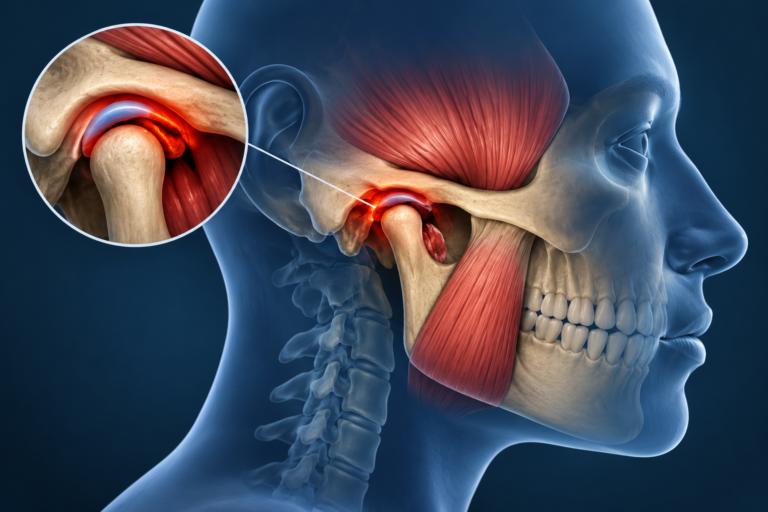

They can look almost the same, but they do different jobs. Here’s how to tell which one fits your teeth and your jaw.
A night guard protects your teeth from grinding and clenching. A TMJ splint is made to take strain off your jaw joint and chewing muscles. They can look almost the same, but they’re shaped, adjusted, and checked differently.
So which one do you need? It depends on where the trouble is. If your teeth are wearing down but your jaw feels fine, a night guard is usually enough. If your jaw aches, feels tight, or tires out, a splint may make more sense.
Below, we’ll compare the two side by side. We’ll also cover what each one can and can’t do, and what to expect if you get one. And we’ll be upfront about the research, because it’s more mixed than most dental websites let on.
What’s the difference between a night guard and a TMJ splint?
The main difference is the job. A night guard is a shield for your teeth. A TMJ splint is a tool for your jaw, so it’s shaped and adjusted with your joint and muscles in mind.
Both cover your upper or lower teeth. Both are usually worn while you sleep. Many are made from the same hard, clear plastic. That’s why people mix them up, and why the two names often get used for the same thing.
Night guard vs TMJ splint at a glance:
| Night guard | TMJ splint | |
|---|---|---|
| Main job | Protects your teeth from grinding and clenching | Eases strain on your jaw joint and chewing muscles |
| Best fit for | Worn, chipped, or sore teeth, with little or no jaw pain | A sore, tight, or tired jaw, often worst in the morning |
| Made of | Hard or soft plastic | Usually hard acrylic |
| Biting surface | Smooth, so your teeth grind on plastic instead of each other | Flat and smooth, adjusted so your teeth touch it evenly |
| Fitting | Fitted once, then checked at your regular visits | Fitted, then adjusted at follow-up visits |
| When you wear it | At night | Usually at night, on your dentist’s plan |
| What it won’t do | Stop you from grinding | Cure TMJ problems or change your bite |
Here’s a simple way to think about it. A night guard is like a seat cover. It takes the wear so the seat doesn’t. A splint is more like a support for a sore knee. You wear it for a stretch of time, and someone checks how it’s working.
What is a night guard?
A night guard is a thin cover that fits over your teeth while you sleep. It takes the wear from grinding and clenching, so your teeth don’t have to.
Grinding at night is common, and most people don’t know they do it. Sometimes a partner hears it. More often, a dentist spots it first. The signs are flat edges, small chips, and fillings that keep breaking.
That’s where a night guard earns its keep. It can’t stop the grinding. What it does is move the damage onto a piece of plastic that’s easy to replace. Your teeth aren’t. If your teeth are already worn flat, here’s what grinding does to worn-down teeth.
You can buy a night guard at the drugstore or have one made by a dentist. Cleveland Clinic notes that a custom guard can last several years with good care. Store-bought ones may need replacing a few times a year.
What is a TMJ splint?
A TMJ splint is a hard, custom-made appliance that covers your upper or lower teeth. It’s adjusted to take strain off your jaw. You might also hear it called an occlusal splint, a bite splint, or an oral appliance.
TMJ is the name of your jaw joint. You have one in front of each ear. When that joint or the muscles that move your jaw aren’t working well, it’s called TMD, or temporomandibular disorder.
The most common type is a stabilization splint. The TMJ Association describes it as hard acrylic with a flat surface. That surface is meant to help reduce grinding and relax sore jaw muscles. It doesn’t stop clenching, though, because your teeth can still press against it.
There’s another type called a repositioning splint. It’s built to hold your lower jaw forward or back. We’re careful with these. The TMJ Association warns that wearing one for more than about six weeks raises the risk of lasting changes to your bite.
What does a TMJ splint look like?
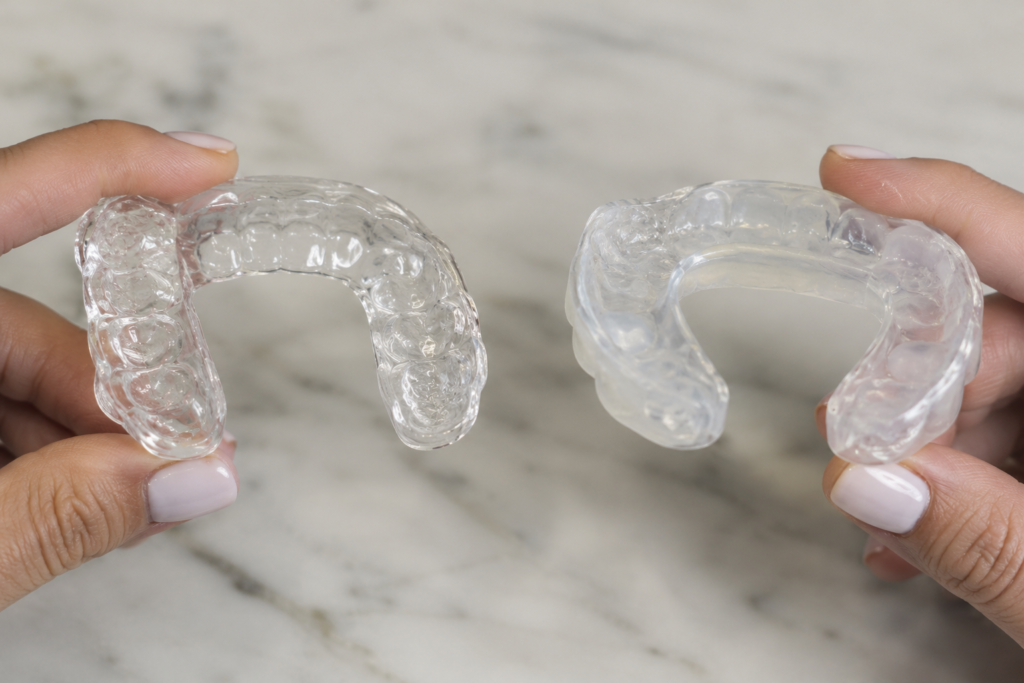
Most TMJ splints look like a clear, hard plastic tray. It covers all of your top or bottom teeth. The biting side is smooth and mostly flat, and it should sit snugly without rocking.
Side by side, a splint and a hard night guard can look nearly identical. The difference is in how the biting surface is shaped and adjusted. That’s hard to see in a photo, but your jaw can feel it.
Can a night guard help with TMJ?
Sometimes. A night guard can ease the load on tired jaw muscles when grinding or clenching is part of the problem. But it isn’t a TMJ treatment on its own, and the research on these appliances is mixed.
Here’s what the research says. The National Institute of Dental and Craniofacial Research (NIDCR) says these appliances protect the teeth and may help with clenching. It also says there isn’t a lot of evidence that they improve TMD pain.
A 2023 review in the Saudi Dental Journal found something similar. Splints helped some people in the short term. Over the long run, they worked about as well as other care, like physical therapy. They weren’t clearly better.
So why use them at all? NIDCR says experts recommend simple, conservative care first. They also advise avoiding treatments that permanently change your jaw, teeth, or bite. An appliance fits that rule, because you can take it out. And when grinding is part of the picture, it protects your teeth either way.
Which one do you need?
It depends on what hurts. If the problem is your teeth, a night guard is usually the answer. If the problem is your jaw, a splint is more likely. If it’s both, which is common, the appliance has to do both jobs.
Where to start, by symptom:
| If this sounds like you | What we’d usually start with |
|---|---|
| Your teeth are worn, chipped, or sore when you wake up, but your jaw feels fine | A custom night guard |
| Your jaw aches, feels tight, or gets tired, especially in the morning | An exam, then likely a stabilization splint |
| Your jaw clicks, but it doesn’t hurt | Often nothing. A painless click is usually normal. |
| Your teeth are worn and your jaw is sore | A splint that also protects your teeth |
| Your jaw catches or locks, or you can’t open as wide as before | An exam soon, before any appliance |
| Your jaw has hurt for months | An exam, and maybe a referral to an orofacial pain specialist |
These are starting points, not a diagnosis. Not sure about the clicking? Here’s when a clicking jaw is normal. The only way to know which appliance fits is an exam of your jaw joint, your chewing muscles, and your teeth together.
How long do you wear a TMJ splint?
Most people wear a TMJ splint at night while they sleep. How many weeks or months depends on your symptoms, and your dentist should check it along the way. A night guard is different. If you grind, you may wear one every night for years.
There’s no set rule for splints. The 2023 review in the Saudi Dental Journal says so, and it suggests wearing them only at night. Wearing one around the clock can cause bite changes that don’t go back.
Here’s what we tell our patients:
– Wear it when we tell you to. For most people, that’s at night.
– Bring it to your follow-up visits so we can check the fit and adjust it.
– If it causes new pain, stop wearing it and call us. NIDCR gives the same advice.
– Tell us if your bite feels different after you take it out. A splint shouldn’t change how your teeth fit together.
– Rinse and brush it each morning, and keep it in its case.
TMJ splint before and after: what changes and what doesn’t
A splint can ease strain on your jaw and protect your teeth. It can’t promise your pain will go away, and it shouldn’t change how your teeth fit together. Here’s an honest look at what to expect.
What a splint can and can’t do:
| What may change | What won’t | |
|---|---|---|
| Jaw muscles | Some people wake up with less soreness or tightness | There’s no guarantee. Results vary a lot from person to person. |
| Teeth | They stop taking the damage from grinding | You may still grind. The plastic just takes the wear. |
| Bite | Nothing. It shouldn’t change. | If your bite feels different, tell us. |
| Clicking | A splint isn’t designed to stop a click | A painless click often stays, and that’s usually fine |
Before-and-after stories online tend to show the best results. Some people feel better within a few weeks. Some don’t notice much. A few feel worse, and that’s a reason to stop and get rechecked, not to push through.
If a splint hasn’t helped after a fair try, the next step is a closer look at what’s going on. It’s not a bigger or fancier appliance.
Does a TMJ splint change your bite?
It shouldn’t. NIDCR says these appliances don’t change the teeth or bite. It also advises making sure any appliance you get isn’t designed to permanently change your bite.
That matters because some offices sell bite changes as a TMJ fix. That can mean grinding teeth down, adding crowns, or using braces to move the jaw. NIDCR says experts recommend avoiding treatments that permanently change the jaw, teeth, or bite. We follow that.
There’s one exception. A new filling or crown that sits too high can make your teeth hit it first every time you bite. Fixing that is a quick adjustment, and it’s the right call.
Can I just buy a night guard at the drugstore?
Because grinding and clenching don’t just tire out your jaw. They also wear down, chip, and crack your teeth.
Dr. Tex puts it simply. Most problems in your mouth come from one of two things. Bacteria cause cavities and gum disease. Force causes most of the rest.
We see force damage every day. It shows up as worn edges, cracked fillings, broken crowns, and bonding that keeps chipping. We repair that damage, too. So before we choose an appliance, we look at your teeth and your jaw together.
A night guard that protects your teeth but ignores a sore jaw misses half the story. So does a splint that ignores a cracked tooth.
One more thing to mention at your visit: snoring or waking up tired. Clenching at night can be associated with sleep breathing problems. If that sounds familiar, we may suggest a sleep apnea evaluation too.
When isn’t a splint enough?
When jaw pain lasts for months, keeps coming back, or spreads into your face, head, or neck. At that point, an appliance alone usually isn’t the answer, and someone with more training should take a look.
That person is often an orofacial pain specialist. That’s a dentist with advanced training in long-lasting pain of the face and jaw. NIDCR suggests seeing one for a second opinion. If your exam points that way, we’ll tell you, and we’ll help you find one.
A physical therapist who works with jaws can help, too. That kind of care often goes alongside a splint.
Getting the right appliance in Sacramento
If you grind, clench, or wake up with a sore jaw, an exam tells you which appliance makes sense. It can also tell you if you need one at all. At our Arden-Arcade office, Dr. Tex does the exam himself. He looks at your jaw joint, your chewing muscles, and your teeth in one visit.
Here’s how it works:
1. Exam. We check how your jaw opens and moves, feel the chewing muscles, and look for wear on your teeth.
2. Scan. We take a digital scan of your teeth, so the appliance is made to fit you.
3. Fitting. We place it and adjust it until your teeth touch it evenly.
4. Follow-up. We check how it’s working and adjust it again if needed.
Call (916) 972-0788 or find out where your jaw pain is coming from. Our office is at 1733 Professional Dr, Sacramento, CA 95825.
Night guard and TMJ splint questions we hear from patients
What’s the difference between a TMJ splint and a night guard?
A night guard protects your teeth from grinding and clenching. A TMJ splint is a hard, custom appliance that’s shaped and adjusted to take strain off your jaw joint and chewing muscles. They can look almost the same. The difference is the goal, and how closely the appliance is adjusted and checked over time.
Can a night guard help with TMJ?
Sometimes. A night guard can ease the load on tired jaw muscles when grinding or clenching is part of the problem. But NIDCR says there isn’t a lot of evidence that these appliances improve TMD pain. We treat a night guard as a simple first step you can stop anytime, not a promise.
Is a splint or a mouth guard better for TMJ?
For jaw pain, a custom splint is usually the better choice, because it’s adjusted to your bite and checked over time. A store-bought mouth guard isn’t fitted to how your teeth meet. If your jaw feels fine and only your teeth are wearing down, a night guard is often all you need.
Does a TMJ splint change your bite?
It shouldn’t. NIDCR says these appliances don’t change your teeth or bite, and that you should make sure any appliance isn’t designed to permanently change your bite. Splints that hold your jaw forward carry more risk if they’re worn too long. Tell your dentist if your bite feels different.
How long do you wear a mouth guard for TMJ?
Most people wear a TMJ splint at night while they sleep, for as many weeks or months as their symptoms call for. There’s no fixed rule, so your dentist should check it along the way. Wearing a splint all day and all night can change your bite, so don’t do that unless you’re told to.
Can TMJ be cured with a splint?
No appliance can promise a cure. A splint can ease strain on your jaw and protect your teeth, and some people feel better with one. A 2023 research review found that over time, splints work about as well as other conservative care, not better. If your pain lasts for months, see an orofacial pain specialist.
Can a night guard make jaw pain worse?
It can. A guard that doesn’t fit well, or one that makes you clench harder, can leave your jaw sorer than before. NIDCR says to stop using an appliance and talk to your dentist or doctor if it causes pain. That goes for drugstore guards and custom ones alike.
Do you wear a TMJ splint during the day?
Usually not. Most splints are worn only at night. A 2023 review in the Saudi Dental Journal suggests nighttime wear and warns that wearing a splint around the clock may cause bite changes that don’t go back. Your dentist might suggest some daytime wear for a short time. Follow their plan.
Is a TMJ splint covered by insurance?
It depends on your plan. TMJ care is sometimes billed to medical insurance instead of dental, and dental plans vary a lot in what they cover for night guards and splints. We’ll check your benefits before your visit and tell you the cost before anything is done.
Why do dentists recommend night guards so often?
Because grinding is common and the damage adds up. Repairing worn, chipped, or cracked teeth is a much bigger job than wearing a guard. That said, not everyone needs one. We recommend a night guard when we see signs of grinding or clenching on your teeth or jaw, not as a routine add-on.
Sources
National Institute of Dental and Craniofacial Research. TMD (Temporomandibular Disorders). Last reviewed September 2026. https://www.nidcr.nih.gov/health-info/tmd
The TMJ Association. Splints. Last modified March 19, 2026. https://tmj.org/living-with-tmj/treatments/splints/
Albagieh H, et al. Occlusal splints: types and effectiveness in temporomandibular disorder management. Saudi Dental Journal, 2023;35(1):70-79. https://pmc.ncbi.nlm.nih.gov/articles/PMC9931504/
Cleveland Clinic. Mouth Guards: Types and Purpose. Last updated January 10, 2023. https://my.clevelandclinic.org/health/treatments/10910-mouthguards
Medical disclaimer: This article is for general information and does not replace an examination and diagnosis by a licensed dentist. Individual results vary.