
A TMJ headache is usually a dull, aching pain at your temples or the sides of your head. It comes from tight chewing muscles and a sore jaw joint. It often gets worse when you chew, yawn, or clench your teeth. It can also feel worse in the morning if you clench or grind at night.
Migraines feel different. They tend to throb, often on one side, and they can bring nausea and a strong dislike of light and sound. Knowing which one you have matters, because each one is treated in a different way, often by a different doctor.
Below, we’ll show you where a TMJ headache hurts and how to compare it to a migraine. We’ll also share a quick test you can try at your desk and the warning signs that mean you should see a doctor right away.
What is a TMJ headache?
A TMJ headache is head pain that starts in your jaw joint or the muscles you chew with. The International Headache Society lists it as its own type of headache in its official guide, the ICHD-3. There, it’s called “headache attributed to temporomandibular disorder.”
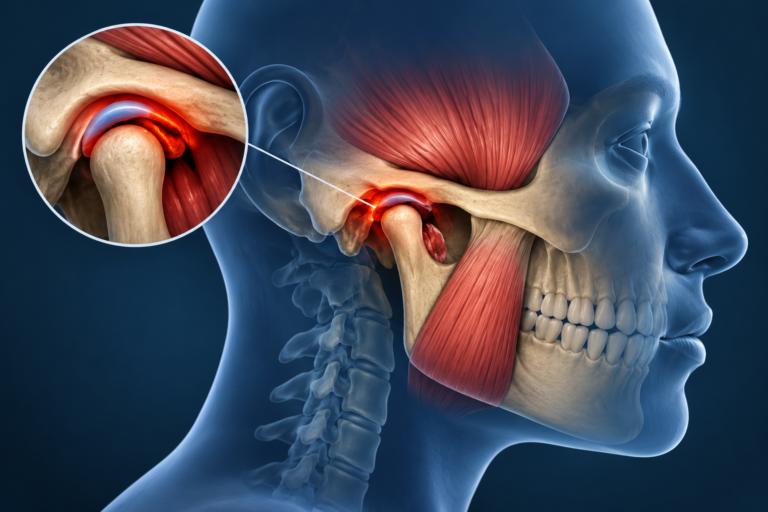
TMJ stands for temporomandibular joint. That’s the hinge in front of each ear that lets your jaw open and close. When that joint or the muscles around it get sore, the problem is called a TMJ disorder, or TMD for short.
Here’s the tricky part. A TMJ headache can feel a lot like a tension headache. The ICHD-3 notes that the two overlap when the pain comes from tight muscles. That’s why some people treat “tension headaches” for years without anyone checking their jaw.
Where is a TMJ headache located?
Most TMJ headaches are felt at the temples, on one or both sides of your head. According to the ICHD-3, the pain is usually strongest in three places:
- Your temples. That’s the flat area on the side of your head, above and in front of your ear.
- Just in front of your ear. This spot sits right over the jaw joint.
- Your cheek and the back corner of your jaw. Your biggest chewing muscle, the masseter, lives here.
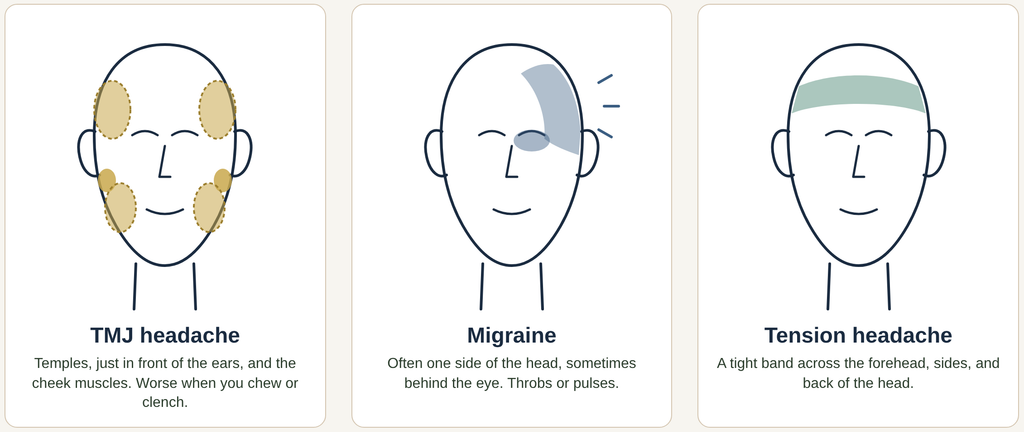
The pain can spread, too. It often reaches the face. The Mayo Clinic also lists neck pain, eye pain, and aching in and around the ear as signs of a TMJ disorder.
Side matters as well. If only one side of your jaw is the problem, the headache is often on that same side. If both sides are involved, you’re more likely to feel it on both sides of your head.
What does a TMJ headache feel like?
A TMJ headache usually feels like a dull ache or tight pressure, not a sharp or pounding pain. The clue that sets it apart is your jaw. Watch for these signs:
- A dull ache or pressure at your temples
- Pain that gets worse when you chew, talk a lot, or yawn
- Sore spots when you press on your temples, cheeks, or jaw
- A stiff or tired jaw
- Clicking, popping, or grating when you open your mouth
- Aching in or around your ear
You don’t need every sign on this list. But if your headache shows up with jaw symptoms, your jaw is worth a closer look. If clicking is your main concern, our guide to why your jaw clicks or pops covers when it’s normal.
Can TMJ cause headaches?
Yes. TMJ disorders can cause headaches, and the International Headache Society lists them as a known cause. Tight chewing muscles can send pain up into your temples. Clenching, grinding, and chewing can make that pain worse.
The two problems also tend to show up together. A 2024 review in the Journal of Oral & Facial Pain and Headache pooled many studies. It found that people with migraines or tension headaches were much more likely to also have a jaw disorder. The link was strongest for people with chronic migraine and for jaw problems that hurt.
The National Institute of Dental and Craniofacial Research (NIDCR) says the same thing in plain terms. TMD often happens along with other problems, like headaches, back pain, and trouble sleeping.
How can you tell a TMJ headache from a migraine?
Look at where it hurts, how it feels, and what sets it off. A TMJ headache aches at the temples and gets worse when you use your jaw. A migraine usually throbs, often on one side, and can bring nausea, light and sound sensitivity, or an aura.
An aura is a warning sign before a migraine, most often a change in how you see. Without treatment, a migraine attack usually lasts 4 to 72 hours, according to the Mayo Clinic. A TMJ headache doesn’t come with an aura.
Use this table to sort out what your headache may be pointing to, and who can help:
| Where it hurts | When it happens | What it may point to | Who to see |
|---|---|---|---|
| Temples, in front of the ears, cheeks, or jaw | Gets worse when you chew, yawn, or clench. Can be worse after a night of grinding | TMJ headache | A dentist who evaluates TMJ |
| Often one side of the head, sometimes behind the eye. Throbs or pulses | Comes in attacks that can last 4 to 72 hours. Can bring nausea, light and sound sensitivity, or an aura | Migraine | Your doctor or a neurologist |
| Forehead, sides, and back of the head, like a tight band | Dull pressure that can last from 30 minutes to a week. Often comes with sore neck and shoulders | Tension headache | Your doctor. Have your jaw checked too if chewing makes it worse |
| Hard to pin down. Shows up right as you wake up | Most mornings, along with snoring, poor sleep, or brain fog | A sleep-related headache | Your doctor or a sleep physician. Read our post on morning headaches and brain fog |
| Anywhere | Sudden and severe. Hits full strength within about a minute, or it’s the worst headache of your life | A possible emergency | Call 911 or go to the ER |
Tension headaches deserve a second look here. The Mayo Clinic describes them as a dull ache with tightness across the forehead or the sides and back of the head. That sounds a lot like a TMJ headache. The difference is your jaw. If chewing, clenching, or pressing on your temples sets off the pain, your jaw muscles may be the source.
How do you know if your headache is from TMJ?
The best clue is whether using your jaw brings on your usual headache. Try this quick check. It takes about a minute:
- Sit down and relax your face. Let your teeth come apart.
- Place two or three fingertips on each temple, just above and in front of your ears.
- Clench your back teeth together for about five seconds. You’ll feel the muscle bulge under your fingers.
- Relax. Then press gently on that same spot, and on your cheeks near the back of your jaw.
- Open your mouth wide and close it a few times.
Did clenching, pressing, or opening wide bring on pain that feels like your headache? If so, your jaw muscles may be part of the problem. Doctors look for something similar. The ICHD-3 lists headache that starts when the temple muscle is pressed, or when the jaw moves, as one sign of a TMJ headache.
This check isn’t a diagnosis. It’s a clue to bring to your exam. To see how far your jaw opens, try the three-finger test in our jaw clicking guide.
Can you have a TMJ headache and a migraine at the same time?
Yes, and it’s common. In the 2024 review, the link between jaw disorders and headaches was strongest in people with chronic migraine. Having both can make each one harder to manage.
A 2017 review in the Journal of the Korean Association of Oral and Maxillofacial Surgeons found that headaches on top of TMD make jaw pain happen more often and feel stronger. Its authors say both problems need care early, often from more than one kind of provider.
That’s why we don’t assume your headaches are “just your jaw.” If you have migraines, keep working with your doctor on them. Easing the strain on your jaw may help, but it doesn’t replace migraine care.
What causes TMJ headaches?
Most TMJ headaches come from overworked jaw muscles. Clenching, grinding, and chewing habits keep those muscles tight for hours. When the muscles at your temples stay tight, it can feel like a headache.
The Mayo Clinic lists these habits and problems as common causes and risk factors:
- Clenching your teeth during the day, often without noticing
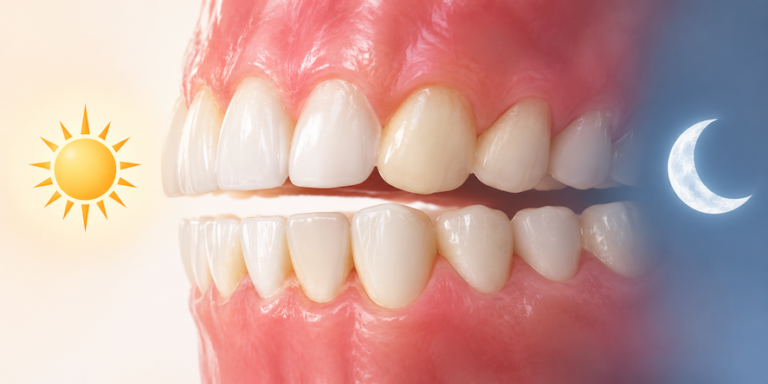
- Grinding or clenching your teeth at night while you sleep
- Chewing gum or biting your nails
- A disk in the jaw joint that has moved out of place
- Arthritis in the jaw joint
- A hit or injury to the jaw
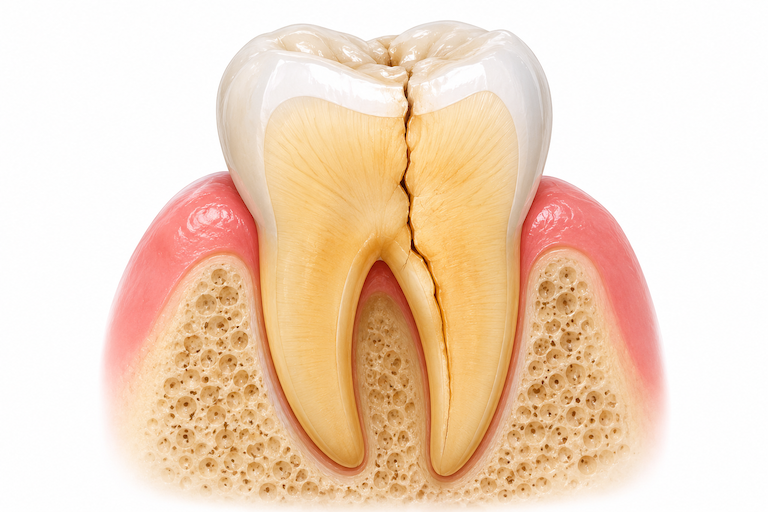
Dental problems rarely start where they hurt. A headache at your temple can begin with force on your teeth and jaw. That same force can also wear your teeth down or crack a tooth. So when you come in for a headache, we look at your teeth, your jaw, and your habits together. It’s all part of our TMJ and bite evaluation.
What if your headaches show up mostly when you wake up? Clenching at night is one possible reason. Sleep is another. Morning headaches can be associated with sleep problems like sleep apnea. We cover that side in our post on morning headaches and brain fog, and our sleep apnea evaluation is one place to start.
Is a TMJ headache dangerous?
On its own, a TMJ headache usually isn’t dangerous. NIDCR notes that many jaw joint and muscle problems are temporary and don’t get worse. But some headaches need a doctor right away, and you can’t always tell the cause on your own.
Call 911 or go to the emergency room if your headache:
- Comes on suddenly and hits full strength within about a minute
- Is the worst headache you’ve ever had
- Comes with confusion, fainting, or trouble speaking, seeing, or walking
- Comes with numbness, weakness, or paralysis on one side of your body
- Comes with a stiff neck or a high fever
- Comes with nausea or throwing up that isn’t from the flu or a hangover
Make a regular doctor’s appointment if your headaches:
- Happen more often than usual
- Are worse than usual
- Don’t get better with over-the-counter pain relievers used as directed
- Keep you from working, sleeping, or doing your normal activities
These lists come from the Mayo Clinic. A dentist can check your jaw. But a dentist can’t rule out every other cause of a headache. If any of these signs fit, see a physician first.
How do you get rid of a TMJ headache?
Start simple. Most TMJ headaches get better with reversible care, which means steps that don’t permanently change your teeth or jaw. NIDCR notes that TMD symptoms go away without treatment for many people.
These at-home steps come from the Mayo Clinic’s self-care advice:
- Give your jaw a break. Eat softer foods and cut food into smaller bites.
- Skip gum and very chewy or sticky foods.
- Don’t open your mouth too wide when you yawn or take a big bite.
- Put warm, moist heat or an ice pack on the side of your face.
- Try gentle jaw stretches and massage. A physical therapist can show you how.
One more habit helps a lot: keep your lips together and your teeth apart. Your teeth should only touch when you chew and swallow.
If home care isn’t enough, these are common next steps:
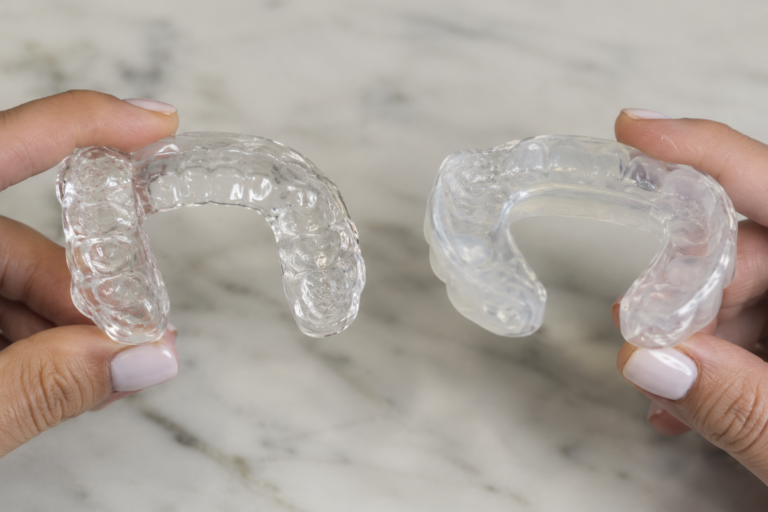
- A custom night guard or TMJ splint, especially if you clench or grind at night. Here’s how to tell which one you need.
- Physical therapy to stretch and strengthen your jaw muscles.
- Counseling or stress tools to help you notice and stop clenching.
- A referral to an orofacial pain specialist if your pain has lasted a long time. That’s a dentist with advanced training in jaw and face pain.
Here’s what we won’t do: grind down or reshape your bite to treat TMJ. NIDCR says there isn’t enough evidence that those bite changes work for TMD. We also don’t offer Botox for TMJ; we’ll point you to someone who does.
When should you see a dentist for a TMJ headache?
See a dentist if your headaches keep coming back along with jaw pain, clicking, or a tired jaw. It’s also worth a visit if chewing makes your headache worse, or if your “tension headaches” haven’t improved with the usual care.
Here’s what a TMJ visit with Dr. Tex looks like:
- We listen first. You tell us where it hurts, when it started, and what makes it better or worse.
- We check your jaw. Dr. Tex feels the jaw muscles and joint, watches how your jaw opens, and listens for clicking.
- We look at your teeth. Wear, chips, and cracks can show years of clenching or grinding.
- We take images if needed. 3D imaging lets us see the jaw joint itself.
- We review it together and make a plan. The plan starts with the simplest, reversible steps. If your headache points to a migraine or another cause, we’ll tell you and help you find the right doctor.
Find out where your headache is coming from
If your headaches live at your temples and your jaw feels tight or tired, your jaw may be part of the story. Dr. Tex evaluates TMJ as part of a full exam, so we look at your jaw, your teeth, and your habits together.
Find out where your headache is coming from with a TMJ and bite evaluation at our Arden-Arcade office. We’re at 1733 Professional Dr, Sacramento, CA 95825. Call us at (916) 972-0788.
Frequently asked questions About TMJ Headache
Where is a TMJ headache located?
A TMJ headache is usually felt at the temples, on one or both sides of the head. It can also hurt just in front of the ears and in the cheeks near the back of the jaw. If one side of your jaw is the problem, the headache is often on that same side.
What does a TMJ headache feel like?
Most TMJ headaches feel like a dull ache or tight pressure at the temples. The pain often gets worse when you chew, yawn, or clench. Many people also notice a sore or tired jaw, tender spots on the sides of the face, or clicking when they open their mouth.
Can TMJ cause headaches?
Yes. The International Headache Society lists headache caused by a TMJ disorder as its own type of headache. Tight chewing muscles and a sore jaw joint can send pain to the temples and the sides of the head. Clenching and grinding can make it worse.
Is a TMJ headache dangerous?
On its own, a TMJ headache usually isn’t dangerous. But get emergency care for a sudden, severe headache, the worst headache of your life, or a headache with confusion, weakness, trouble speaking or seeing, a stiff neck, or a high fever. Those signs need a doctor right away.
How do I know if my headache is from TMJ?
Look for jaw clues. A TMJ headache usually sits at the temples, gets worse when you chew or clench, and comes with a sore jaw, tender face muscles, or clicking. If pressing on your temples or opening wide brings on your usual headache, have your jaw checked.
How is a TMJ headache different from a migraine?
A TMJ headache is usually a dull ache at the temples that gets worse when you use your jaw. A migraine usually throbs, often on one side, and can bring nausea, light and sound sensitivity, or an aura. Without treatment, a migraine attack often lasts 4 to 72 hours.
Can grinding your teeth cause headaches?
Yes, it can. Grinding and clenching overwork the chewing muscles at your temples and jaw, and the Mayo Clinic lists both as risk factors for TMJ disorders. If you wake up with sore temples or a tired jaw, grinding at night may be part of the cause.
Does a night guard stop clenching?
No. A night guard protects your teeth from the force of clenching, but it doesn’t stop the habit. NIDCR says a mouth guard may reduce muscle activity from clenching and grinding. A hard, custom guard fits your bite, and some people find they clench more on a soft one.
Can clenching your jaw cause headaches?
Yes. Mayo Clinic lists a dull headache that starts at your temples as a sign of clenching and grinding, and tension-type headaches as a possible result. If you wake up with headaches often, ask about your sleep too. Morning headaches can have other causes, including sleep problems.
How do you get rid of a TMJ headache?
Start with your jaw. Eat softer foods, skip gum, put heat or an ice pack on the side of your face, and keep your teeth apart when you’re not eating. If that isn’t enough, a custom night guard or splint and physical therapy are common next steps.
Can you have a TMJ headache and a migraine at the same time?
Yes. Studies show that people with migraines are more likely to also have a jaw disorder, and having both can make each one harder to manage. If you have both, keep working with your doctor on your migraines while we help ease the strain on your jaw.
Does a night guard help TMJ headaches?
It can help if clenching or grinding at night is part of the problem. The Mayo Clinic notes that many people with jaw pain benefit from a splint or mouth guard. It won’t treat a migraine, though, so the first step is making sure you’re treating the right headache.
Who should I see for a TMJ headache?
Start with a dentist who evaluates TMJ if your headache comes with jaw pain, clicking, or a tired jaw. See your doctor first if your headaches are new, getting worse, or come with nausea, vision changes, or other warning signs. For long-lasting jaw pain, an orofacial pain specialist is the next step.
Sources
- International Headache Society. ICHD-3, 11.7 Headache attributed to temporomandibular disorder (TMD). https://ichd-3.org/11-headache-or-facial-pain-attributed-to-disorder-of-the-cranium-neck-eyes-ears-nose-sinuses-teeth-mouth-or-other-facial-or-cervical-structure/11-7-headache-attributed-to-temporomandibular-disorder-tmd/
- National Institute of Dental and Craniofacial Research. TMD (Temporomandibular Disorders). Last reviewed September 2026. https://www.nidcr.nih.gov/health-info/tmj
- Mayo Clinic. TMJ disorders: Symptoms and causes. https://www.mayoclinic.org/diseases-conditions/tmj/symptoms-causes/syc-20350941
- Mayo Clinic. TMJ disorders: Diagnosis and treatment. https://www.mayoclinic.org/diseases-conditions/tmj/diagnosis-treatment/drc-20350945
- Mayo Clinic. Migraine: Symptoms and causes. https://www.mayoclinic.org/diseases-conditions/migraine-headache/symptoms-causes/syc-20360201
- Mayo Clinic. Tension headache: Symptoms and causes. https://www.mayoclinic.org/diseases-conditions/tension-headache/symptoms-causes/syc-20353977
- Mayo Clinic. Headache: When to see a doctor. https://www.mayoclinic.org/symptoms/headache/basics/when-to-see-doctor/sym-20050800
- Bizzarri P, Manfredini D, Koutris M, et al. Temporomandibular disorders in migraine and tension-type headache patients: a systematic review with meta-analysis. Journal of Oral & Facial Pain and Headache. 2024. https://www.ncbi.nlm.nih.gov/pmc/articles/PMC11810655/
- Abouelhuda AM, Kim HS, Kim SY, Kim YK. Association between headache and temporomandibular disorder. J Korean Assoc Oral Maxillofac Surg. 2017;43(6):363-367. https://pmc.ncbi.nlm.nih.gov/articles/PMC5756792/
Medical disclaimer: This article is for general information and does not replace an examination and diagnosis by a licensed dentist. Individual results vary.