


TMJ Dentist in Sacramento (Arden-Arcade)
Jaw pain, clicking, clenching, and the cracked teeth that often come with them. We find out where it’s coming from before we treat anything.
Not sure it’s TMJ? Take the quick check
1-on-1 care
Discuss your goals with Dr. Tex
3D imaging in-office
See the joint from every angle
Treatment that lasts
Invest in your smile
If your jaw clicks, aches when you chew, or feels tight when you wake up, a TMJ evaluation tells you where it’s coming from: your chewing muscles, the jaw joint, or your teeth.
As a TMJ dentist in Sacramento’s Arden-Arcade neighborhood, Dr. Tex Mabalon does every evaluation himself. We take the time to get the diagnosis right before we do anything, because care that is planned carefully lasts longer and helps you avoid bigger problems down the road. If your pain is coming from somewhere a dentist can’t fix, we’ll tell you at the first visit and point you to the right person.
What is TMJ, and what is TMD?
TMJ stands for temporomandibular joint, the hinge-and-slide joint in front of each ear that connects your lower jaw to your skull. TMD, or temporomandibular disorder, is the name for problems with that joint or the chewing muscles that move it. Most people say “TMJ” for both. The National Institute of Dental and Craniofacial Research estimates TMD affects about 5% of U.S. adults, and it’s about twice as common in women as in men.
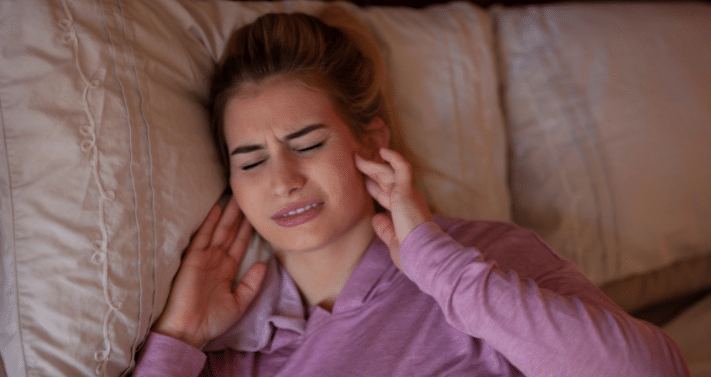
Morning jaw soreness and headaches often trace back to clenching at night.
Find out what’s behind your jaw pain
Send four details and we’ll call you back to book your evaluation.
Or call (916) 972-0788
Your information isn’t shared or sold.
Signs your jaw is worth having checked
Tick what sounds like you. It isn’t a diagnosis. It tells us where to start.
Is jaw clicking a problem?
Jaw clicking without pain is common and usually isn’t a problem, but may be a risk factor. It’s worth an evaluation when the click hurts, when your jaw catches or locks, or when the clicking starts along with new pain or a change in how your teeth fit together. Why does my jaw pop?
EVERY TMJ EVALUATION INCLUDES
Jaw movement
How wide and how straight you open
Joint & muscle exam
Clicks, tender spots, clenching signs
Tooth damage check
Wear, chips, cracks, failing fillings
3D imaging
The joint from every angle, when needed
Muscle, joint, or teeth: where jaw pain comes from
The right care depends on where it starts. That’s the first thing your evaluation figures out.
Your chewing muscles
A dull ache in your cheeks or temples, a tired jaw, morning headaches.
WHAT WE LOOK FOR
Tender spots and signs of clenching or grinding
The jaw joint
Pain in front of the ear, clicking, catching, locking, trouble opening wide.
WHAT WE LOOK FOR
Joint sounds, how far and how straight you open, and the joint itself on 3D imaging
Your teeth
Sore teeth on waking, chipped or worn edges, fillings that keep breaking.
WHAT WE LOOK FOR
Wear patterns, cracks, and fillings or crowns that have broken
Where does jaw pain come from?
Jaw pain usually starts in one of three places: the chewing muscles, the jaw joint, or the teeth. Muscle pain feels like a dull ache in the cheeks or temples. Joint problems cause pain in front of the ear, clicking, or locking. Problems driven by the teeth show up as worn, chipped, or cracked teeth and fillings or crowns that keep breaking.
Your breathing can play a part, too
Airway problems, like snoring or breathing issues during sleep, have been linked with jaw clenching and jaw pain. That’s why your evaluation also looks at how you breathe, and why we may talk with you about a sleep apnea evaluation.
What happens at your TMJ evaluation
Dr. Tex does the exam himself, and it starts with you: what’s bothering you and what you want from your care.
We start with your goals
We listen first: what you’re feeling, what worries you, and what you want from your care. Your goals shape everything that follows.
We look at everything
A full evaluation of your jaw, joints, and muscles, plus every tooth: how you open and move, joint sounds, tender spots, and any wear, chips, or cracks.
We find the cause
We put it together into a diagnosis of where the problem is coming from, and walk you through what it means for you.
We image when needed
3D imaging shows the joint from every angle. If the disc needs a closer look, we refer you for an MRI.
You leave with a plan
In writing: what we found, what we’d try first, and anything we’d refer out.
A TMJ evaluation at our Sacramento office starts with your goals, then looks at everything: your jaw, joints, chewing muscles, and teeth, with 3D imaging of the joint when it’s needed. It ends with a diagnosis of where the problem is coming from and a plan you take home.
How we treat TMJ, starting with what you can undo
Every plan is built around you, and it starts with the most conservative options, the approach the National Institute of Dental and Craniofacial Research recommends.
There’s no one-size-fits-all fix for jaw pain. Sometimes the answer starts with small changes in daily habits. Sometimes it means protecting your teeth from the forces that are wearing them down, or repairing damage that’s already been done, so it doesn’t turn into a bigger problem later. And when the cause is something a dentist doesn’t treat, we’ll point you to the right specialist.
We go slow on purpose. Dr. Tex will walk you through what makes sense for you once he understands your goals and what your evaluation shows, because the right plan is different for every patient, and doing it right is what makes it last.
OUR RULE
Clicking without pain is common, but not normal. Recent jaw pain often settles with simple care. Nobody should have their teeth ground down before trying the things that can be undone.
Do you need a TMJ specialist?
Who treats TMJ?
Most people with jaw pain should start with a dentist who evaluates TMJ, because the exam covers the teeth, bite, and chewing muscles along with the joint. Orofacial pain is a recognized dental specialty for long-standing or complex facial pain. Oral and maxillofacial surgeons treat joint problems that may need injections or surgery, and physical therapists treat tight jaw muscles and limited opening.
| Who | What they do | When to see them |
|---|---|---|
| A dentist who evaluates TMJ | Exam, imaging, diagnosis, and care for jaw, bite, and tooth problems | First stop for most jaw pain, clicking, clenching, and tooth wear |
| Orofacial pain specialist | Chronic facial pain, nerve pain, and headaches | Long-standing pain, or pain that hasn’t improved with earlier care |
| Oral and maxillofacial surgeon | Joint injections, joint flushing (arthrocentesis), surgery | A jaw that locks, or a disc problem confirmed on imaging |
| Physical therapist | Jaw exercises, hands-on therapy, posture | Tight muscles and limited opening |
| Your physician | Rules out ear, sinus, nerve, and heart causes | Ear infection signs, numbness, fever, or chest symptoms |
A dentist who evaluates TMJ
What they do
Exam, imaging, diagnosis, and care for jaw, bite, and tooth problems
When to see them
First stop for most jaw pain, clicking, clenching, and tooth wear
Orofacial pain specialist
What they do
Chronic facial pain, nerve pain, and headaches
When to see them
Long-standing pain, or pain that hasn’t improved with earlier care
Oral and maxillofacial surgeon
What they do
Joint injections, joint flushing (arthrocentesis), surgery
When to see them
A jaw that locks, or a disc problem confirmed on imaging
Physical therapist
What they do
Jaw exercises, hands-on therapy, posture
When to see them
Tight muscles and limited opening
Your physician
What they do
Rules out ear, sinus, nerve, and heart causes
When to see them
Ear infection signs, numbness, fever, or chest symptoms
Why jaw pain and broken teeth are often the same problem
The force that tires your jaw muscles also chips front teeth, wears molars flat, cracks fillings, and breaks crowns. So when you come in for a broken tooth, we check your jaw. When you come in for jaw pain, we check your teeth.
It’s also why we plan every crown, veneer, and implant for the force it will face.
There are two main things that cause problems in dentistry. One is bacteria. The other is force.
DR. TEX MABALON, DDS
BACTERIA
Cavities and gum disease
FORCE
Clenching, grinding, broken teeth, jaw strain
What our patients say
★★★★★
“This office gives great attention to detail and helps the patient truly understand what their options are. So glad there is a dentist like this right here in Sacramento!”
Lisa A.
★★★★★
“With precision, total communication from start to finish, the entire staff walks you through dental procedures. They totally know how to take care of you!”
Julie K.
★★★★★
“Dr Tex has been so solid and patient with me. My teeth have been very challenging and he has stayed by me.”
Marbella S.
TMJ care for Arden-Arcade and nearby
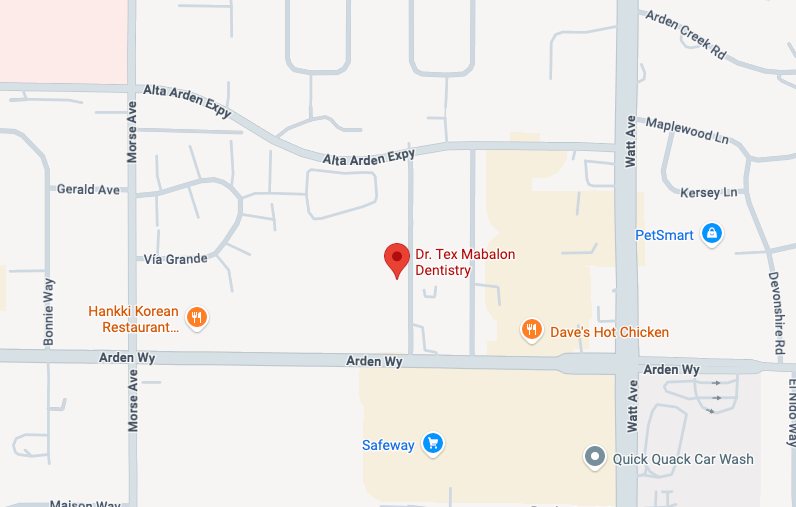
We’re on Professional Drive, just off Fair Oaks Boulevard and about a mile from Arden Fair. Parking is on site.
Dr. Tex Mabalon Dentistry
1733 Professional Dr, Sacramento, CA 95825
Mon, Tue, Thu 8:00am to 4:30pm · Wed 9:00am to 5:30pm
Who does your evaluation
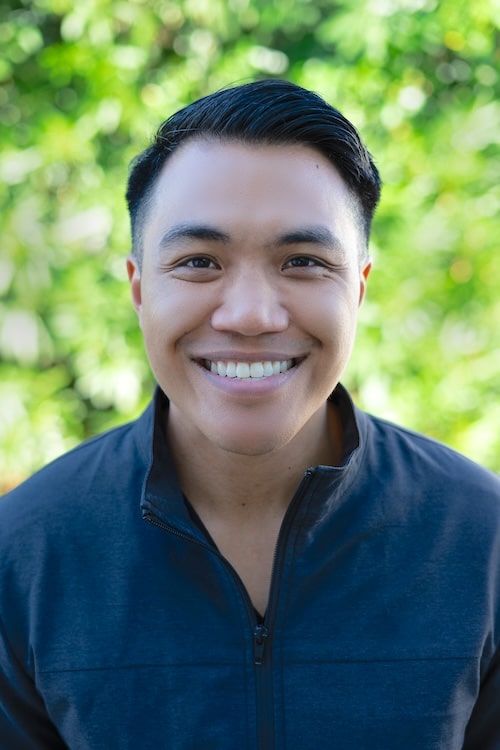
Dr. Tex Mabalon, DDS, trained at the Arthur A. Dugoni School of Dentistry, then at the Kois Center and Spear Education, two programs known for how the teeth, jaw muscles, and joints work together.
He does every TMJ evaluation himself, and he’ll tell you plainly what he thinks is going on.
Medically reviewed by Dr. Tex Mabalon, DDS · October 2026
TMJ questions we hear from Sacramento patients
Find out what’s behind your jaw pain
If your jaw clicks or aches, or your teeth keep chipping, come in and find out why. You’ll leave knowing where it’s coming from and what we’d try first.